The EA Profession Is Splitting in Real Time
From the Editor (and an announcement)
I’ve noticed something recently. I barely finish most of the subscriptions I’m signed up to anymore. They’re sitting in a Friday Reading inbox folder that’s becoming a graveyard of ideas.
The information is as good as it’s always been, but there’s just now an overwhelming amount of it.
Leadership commentary. AI updates. Podcasts. Trend reports. Endless opinions about the future of work.
At some point, more information stopped helping make sense of the world.
What feels more valuable now is the interpretation of the information.
People helping make sense of what is actually changing inside organisations while it’s happening. What leaders are paying attention to. Where operational pressure is building. What is becoming more visible. What is becoming more exposed. What is quietly shifting underneath the surface before it formally arrives in job descriptions, capability frameworks or org charts.
That has always been my intention behind The Brief.
I didn’t want to just talk about the profession, but to help decode the broader business, leadership, organisational and macro conditions shaping it in real time.
And over the past year especially, one pattern has become increasingly difficult for me to ignore:
The profession is no longer evolving evenly.
Some EAs and support teams are actively reshaping how work moves across organisations. They are questioning inherited operational habits, redesigning repetitive workflows, improving communication flow, reducing friction and helping leadership teams operate with greater clarity and less drag.
Others are still operating from models of value that built successful careers for years, but are becoming increasingly exposed as organisations change around them.
What makes this moment particularly complex is that many highly capable EAs are still technically doing excellent jobs.
They are dependable. Responsive. Trusted. Highly experienced.
Meanwhile, the environment around the role is changing faster than many people realise.
Increasingly, organisations are not simply evaluating support through workload or responsiveness alone. They’re starting to notice differences in operational thinking, adaptability, systems awareness and the ability to improve how work actually functions under pressure.
I also think the profession still underestimates how much broader the conversation has become.
This isn’t just about AI.
It is about organisational redesign. Decision fatigue. Operational drag. Cognitive overload. Leaner structures. Faster movement. Visibility. Judgement. Communication flow. The increasing commercial value of people who can reduce complexity instead of adding to it.
And importantly, the people adapting best right now aren’t always the most senior or the most technically advanced.
Often, they are simply the people willing to rethink inherited assumptions earlier than everyone else.
That distinction feels increasingly important.
It’s also part of the reason this will be the final edition of The Brief.
The more I reflected on where the profession is heading, the more I realised another static publication each month no longer felt like the highest-value contribution I could make.
Information is everywhere.
What feels rarer now are spaces where thoughtful people can interpret what’s happening together in real time. Spaces where operational ideas can be explored properly. Spaces where nuance, judgement and deeper conversation still exist underneath the noise.
That’s what I am creating next - space for conversations like these to leave the inbox and happen where they can have the strongest impact. In community. You’ll hear about that first - watch your inbox for more.
Whether you’ve been reading The Brief from the beginning or only joined recently, thank you.
Thank you for trusting me to help decode the business, leadership and organisational shifts shaping the profession behind the scenes.
My hope is that this final edition brings together many of the threads we’ve explored across the past year and helps sharpen how you interpret the environment around you moving forward.
Because despite the complexity of this moment, I remain incredibly optimistic about where the profession could go next.
That’s not because the role should stay exactly as it has always been.
But because there is extraordinary capability, intelligence and untapped operational influence sitting inside this profession when people are willing to rethink where value now sits.
And if you’re someone drawn to conversations like we’ve been covering here in The Brief, chances are you’re already exactly the kind of thoughtful, commercially aware and deeply curious person the profession needs helping shape what comes next.
This edition is based on research and field notes from my conversations with senior executives and People and Culture leaders, insights from my training rooms, observations from the broader community and intel sharing with other thought leaders and advocates in this space.
1. Market Signals
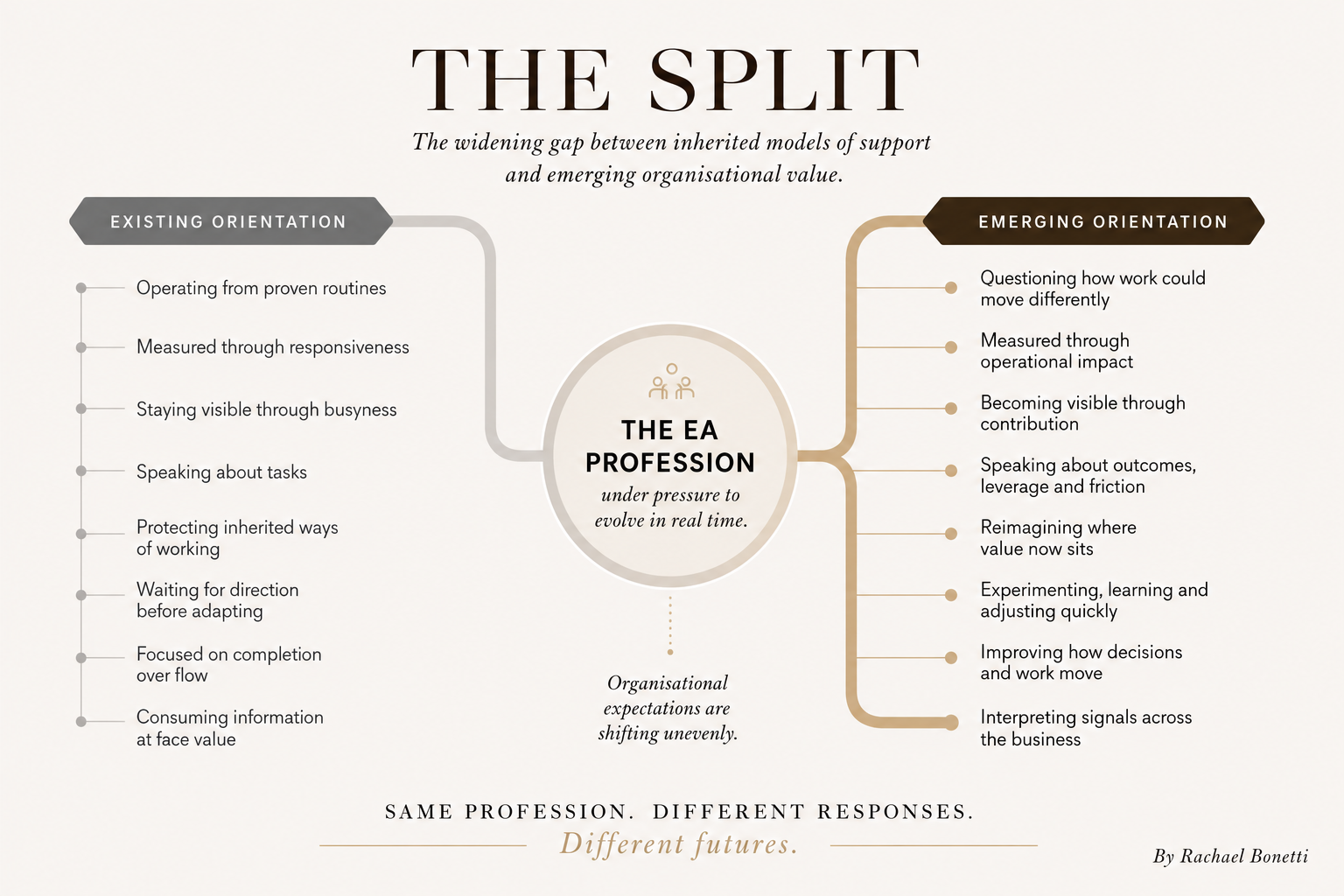
Some executives are beginning to experience support differently enough that it is changing how they evaluate the role altogether.
Not because expectations have suddenly become unreasonable, but because once a leader experiences support that improves prioritisation quality, sharpens communication flow, reduces operational drag and creates genuine decision-making capacity, it changes their understanding of what the role can contribute at its best.
That expectation rarely resets downward again.
Organisations are becoming less interested in paying premium salaries for coordination work that technology is increasingly able to support, accelerate or systemise.
The distinction is starting to move toward people who improve how work operates, not simply people who keep pace with it efficiently.
That shift is subtle right now and it won’t stay that way.
AI is exposing a deeper divide than technical confidence.
Some people are approaching it as a faster way to complete existing tasks, while others are using it to rethink whether the workflow, approval chain, reporting structure or communication pattern should exist in its current form at all.
Those are very different orientations toward work and they are beginning to create very different organisational outcomes.
One of the more confronting shifts underway is that highly capable EAs can now be simultaneously performing well and becoming vulnerable.
Many are still operating exactly as the profession rewarded people to operate for years:
highly responsive,
deeply dependable,
execution-focused,
service-oriented.
Meanwhile, organisations are changing around them through automation, restructuring, operational redesign and rising pressure to move faster with leaner support structures.
The issue is often not capability. It is whether the capability being demonstrated is still interpreted as commercially differentiating inside the environment around it.
2. The Questions Increasingly Revealing the Gap
Organisations are beginning to realise that traditional indicators of excellence in support are no longer sufficient to signal future value. The difference between high-potential and functionally competent support increasingly shows up in how people think, interpret, and act in complex operational environments.
The questions below are the kinds of questions that surface where an EA is truly operating from, revealing the orientation, judgement, and adaptability that will determine their relevance as organisational conditions continue to shift.
-
“Tell me about a process, workflow, or operational habit you recently questioned. What led you to challenge it?”
-
“Where do you think leaders in this organisation lose the most time unnecessarily?”
-
“What business pressures are shaping the executive environment most heavily right now?”
-
“Describe a change you implemented that materially improved how work moved across a team.”
-
“What parts of your role do you think should no longer require human effort?”
-
“How do you decide what deserves escalation versus what can be absorbed operationally?”
-
“If repetitive execution disappeared tomorrow, where would your greatest value still sit?”
-
“What assumptions about the EA role are you still carrying that may already be outdated?”
-
“What work or workflows do you think the team should stop protecting?”
-
“Describe a moment where you recognised friction before anyone else noticed it. How did you respond?”
-
“What signals indicate that leadership or teams are approaching cognitive overload?”
-
“If you were hiring new EA talent into this organisation, what capabilities or ways of thinking would you prioritise differently today?”
3. What's Becoming Harder to Replace
One of the more unhelpful ways organisations are still discussing AI is through a binary lens:
replacement versus protection.
That framing misses where the more interesting change is actually happening.
The stronger organisations are not only asking:
“What can technology do faster?”
They are increasingly asking:
“What still requires human discernment, operational judgement and contextual understanding once speed and execution become easier?”
That distinction is important because the work becoming more valuable isn’t always the most visible work.
Becoming Easier to Accelerate, Systemise or Replicate
Coordination mechanics
Scheduling, calendar optimisation, meeting logistics, status tracking and administrative routing are all becoming easier to automate, streamline or distribute across systems.
The value is shifting away from managing movement manually and toward improving how movement functions overall.
Information retrieval and synthesis
Organisations are becoming significantly faster at retrieving information, summarising content, aggregating updates and generating first-draft communication.
That changes the premium previously placed on being the person who simply held or moved information efficiently.
Repeatable workflow administration
Any workflow built primarily around repetition, consistency and rule-following is becoming increasingly vulnerable to acceleration through technology.
Particularly where the work can be standardised without requiring significant contextual judgement.
Execution visibility
AI and automation are also making previously invisible operational patterns easier to surface:
-
where time gets lost
-
where approvals stall
-
where communication loops repeat
-
where workflows create unnecessary drag.
That visibility is likely to reshape how operational contribution itself gets measured.
Becoming Harder to Replace
Judgement under ambiguity
The ability to make sound operational decisions without perfect information is becoming more valuable, not less.
This particularly matters in environments moving faster than formal structures can comfortably support.
Recognising pressure before it becomes visible
Some of the strongest EAs identify leadership strain, decision fatigue, communication breakdown or operational overload well before it formally surfaces.
That kind of sensing is still deeply human work.
Sequencing and timing
Knowing what needs attention is different from understanding:
-
what needs to happen first
-
what can wait
-
what creates downstream consequences
-
and what pressure the wider environment is already carrying
That level of operational discernment remains difficult to replicate.
Organisational interpretation
Many environments are now producing more information than leaders can meaningfully process.
The value increasingly sits with people capable of interpreting:
-
what matters
-
what is noise
-
what requires escalation
-
what carries risk
-
and what will likely create operational consequence later.
Redesign thinking
Some of the most commercially valuable people emerging inside organisations are doing more than executing workflows well.
They are questioning whether the workflow itself still makes sense.
That orientation toward redesign is becoming increasingly important as organisations reassess how work should move under growing pressure for speed, efficiency and adaptability.
Trust under pressure
As environments become more complex and overloaded, leaders place increasing value on people capable of operating with sound judgement, discretion, calmness and contextual awareness when situations become messy or ambiguous.
Technology may accelerate execution, but trust remains deeply relational.
Translating complexity into simplicity and clarity
The environments many executives now operate inside are fragmented, fast-moving and cognitively heavy.
The people creating the most value are often the people able to simplify, connect dots, improve communication flow and create clarity without oversimplifying the reality underneath it.
That capability is becoming increasingly strategic.
The organisations navigating this shift best aren’t treating AI as an efficiency exercise.
They’re using it to rethink where human contribution becomes most valuable once repetitive execution no longer sits at the centre of the role.
4. What Support Leaders Should Be Assessing Differently Now
Many organisations are still assessing business support capability primarily through responsiveness, reliability and execution consistency.
While this is still important, it no longer tells the full story about future value, adaptability or operational influence inside increasingly complex environments.
The stronger support leaders are beginning to look more closely at how people think, interpret, adapt and improve movement around them.
Can this person recognise friction beyond their immediate workload?
Not just workload pressure, but operational friction:
-
duplicated movement
-
communication breakdown
-
poor sequencing
-
decision bottlenecks
-
unnecessary complexity
-
cognitive overload.
Some people simply absorb friction. Others improve the environment creating it.
That distinction becomes increasingly important at scale.
Does this person improve workflows or simply maintain them efficiently?
Highly capable execution and getting everything done is still valuable.
But today organisations need people capable of questioning workflows, redesigning movement and recognising where effort no longer matches value.
Particularly as AI accelerates how quickly work itself can change.
How well does this person understand the business environment around them?
Not only:
-
their executive’s preferences
-
their own workload
-
their immediate tasks.
But:
-
commercial pressure
-
leadership priorities
-
organisational dynamics
-
decision-making rhythms
-
operational consequences
-
external business conditions
The broader the context someone understands, the more strategically useful their judgement becomes.
Can this person operate effectively when ambiguity increases?
Some people perform strongly inside stable structures and highly defined processes.
Others remain effective when priorities shift quickly, information is incomplete and operational conditions become messy.
That adaptability is becoming increasingly valuable.
Is this person becoming more commercially valuable over time or simply more efficient?
This is a very different question.
Efficiency improves execution.
Commercial value improves organisational outcomes.
The strongest support leaders are beginning to distinguish between the two more carefully.
Does this person interpret AI as a task tool or an operational redesign opportunity?
This question alone increasingly reveals mindset differences inside teams.
Some people are using AI to move existing work faster.
Others are rethinking whether the work itself still needs to happen in its current form.
Those orientations create very different futures.
Can this person translate operational contribution into organisational language?
Many highly capable EAs still dramatically under-describe the level of influence they have because the language they use remains anchored in tasks rather than operational effect.
That translation ability is becoming increasingly important for visibility, investment and organisational recognition.
Does this person help leaders think more clearly?
This is becoming one of the most valuable and least formally measured contributions in the profession.
Especially in environments carrying high complexity, information overload and constant cognitive switching.
The strongest EAs are often improving decision quality, clarity and leadership capacity in ways organisations still struggle to measure properly.
5. Deployment Tools
A. Translating operational contribution into organisational language
One of the biggest visibility gaps inside the profession is not capability.
It is interpretation.
This framework can help reposition support contribution in language that connects more directly to leadership effectiveness, organisational flow and business performance.
DOWNLOAD: THE TRANSLATION FRAMEWORK HERE
B. Questions organisations should be asking about support capability right
As operational environments become faster, leaner and increasingly complex, many organisations are still assessing support capability through frameworks designed for very different conditions.
The following questions are intended to support broader conversations around operational leverage, leadership effectiveness, workflow design and future capability inside support functions.
-
Are support teams primarily absorbing operational complexity or helping reduce it?
-
Which support capabilities would become hardest to replace if removed tomorrow?
-
Are current capability frameworks assessing future organisational value or historical role expectations?
-
Which people consistently improve how work moves across teams, communication and leadership environments?
-
As execution accelerates through technology, which human capabilities are becoming more commercially differentiating?
The organisations likely to navigate this shift most effectively are unlikely to be the organisations asking how to preserve inherited support models unchanged.
They are more likely to be the organisations willing to reassess where operational value now sits, which capabilities create the greatest leverage under pressure and how support functions can evolve alongside the environments around them.
C. Email Scripts and Talking Points
“I’m noticing some of the operational friction we experience now seems more connected to workflow design than workload volume.”
“I wonder whether parts of this process still reflect how the organisation operated historically rather than how work is moving today.”
“One of the patterns becoming more visible across organisations is the difference between support that maintains movement and support that improves operational flow.”
“It may be useful to look at where coordination complexity is creating unnecessary cognitive load around leadership teams.”
“I think there’s an opportunity to reassess which parts of support work genuinely require human judgement and which parts are continuing primarily through habit.”
D. Executive Ready Notes
When you only have a few minutes to prepare, this is your shortcut.
A one-page executive-level summary designed to help you think through:
Whether your business support operations is still fit for purpose
Where your talent pipeline exists and;
Where to focus development
And where there are opportunities to reshape the way your support function moves in a new landscape
DOWNLOAD: EXECUTIVE READY NOTES HERE
6. Using The Brief with Care
Not every inherited workflow is outdated.
Not every form of friction signals poor design.
And not every organisation is operating from the same assumptions about support capability, operational leverage or workflow maturity.
The shifts explored throughout this edition are also unlikely to appear evenly across environments.
Apply judgement before assuming every signal requires immediate redesign, escalation or change inside your own organisation.
The goal is not to force reinvention for the sake of it.
It is to become more intentional about recognising where organisational conditions, leadership expectations and operational value may already be shifting underneath the surface.
7. Urgency
This edition matters now because many organisations are accelerating work faster than they are redesigning how work actually moves underneath that acceleration.
That tension is beginning to surface through:
-
leadership overload
-
growing coordination complexity
-
fragmented communication
-
duplicated movement
-
hidden manual work
-
increasing cognitive load across teams
At the same time, organisations are quietly reassessing:
which capabilities create leverage,
which work still requires human judgement,
and where operational value now sits.
Many EAs and support leaders see those shifts earlier than most.
That visibility matters.
8. Go Deeper: Curated Reading
The Strategic EA Reset
A free self-audit for EAs wanting to better identify, interpret and articulate the operational value they may already be creating inside increasingly complex environments. You might find this useful to share with your support function as a private self-assessment and development resource.
How Should Executive Assistant Performance Be Measured?
A companion piece for readers wanting to take the ideas explored throughout this edition into performance, capability and organisational measurement conversations. It expands on why volume and responsiveness are increasingly incomplete measures of value, and includes a free Executive Assistant Measurement Framework designed to help organisations assess operational contribution more meaningfully.
9. Audio Briefing
Prefer to listen instead of read?
Each month, you’ll also find a short audio briefing from me. Think of it as a five-minute download: the context behind this edition, the shifts worth paying attention to, and the lens to carry into your thinking this month.
LISTEN TO YOUR AUDIO BRIEFING HERE
WHAT COMES NEXT
Over the past year, one thing has become increasingly clear to me.
The challenge is no longer access to information, it’s how we interpret the information.
Understanding what actually matters beneath the noise. Recognising which shifts are structural and which are temporary. Identifying where organisational value is moving while environments themselves are still changing in real time.
That is part of the reason this will be the final edition of The Brief.
I believe these conversations still matter.
EAs need decoded business insights that help them use their judgement in an advanced way, but I don’t think static information alone is the right format for what the moment requires.
Not when we are being flooded with more content, more noise and more information.
What comes next is The Advisory Room.
I’ll share more when it’s ready but for now, thank you.
Thank you for reading, responding to and supporting The Brief over the past year. Some of the most thoughtful conversations I’ve had about the profession have started because of it.
And despite the complexity sitting underneath this moment, I remain incredibly optimistic about where the profession could go next.
The environment isn’t becoming simpler, but the people willing to engage with it thoughtfully are becoming easier to recognise.

