Theme: The “We’ve Always Done It This Way” Problem
When familiarity becomes operational drag
What's Inside
Market Pulse
Organisations are investing heavily in AI, automation and productivity initiatives while still carrying workflows, assumptions and meeting rhythms built for conditions that no longer exist.
Global signals decoded:
Recent HBR thinking on organisational forgetting argues that what often constrains organisations isn't a lack of capability, but the accumulation of outdated ways of working that quietly continue shaping decisions long after the environment around them has changed.
Overlooked Risk
Automating inherited workflows without questioning whether they still serve the organisation can scale inefficiency rather than reduce it. Familiar work often survives because it feels safer to maintain than to rethink.
Framework Snapshot
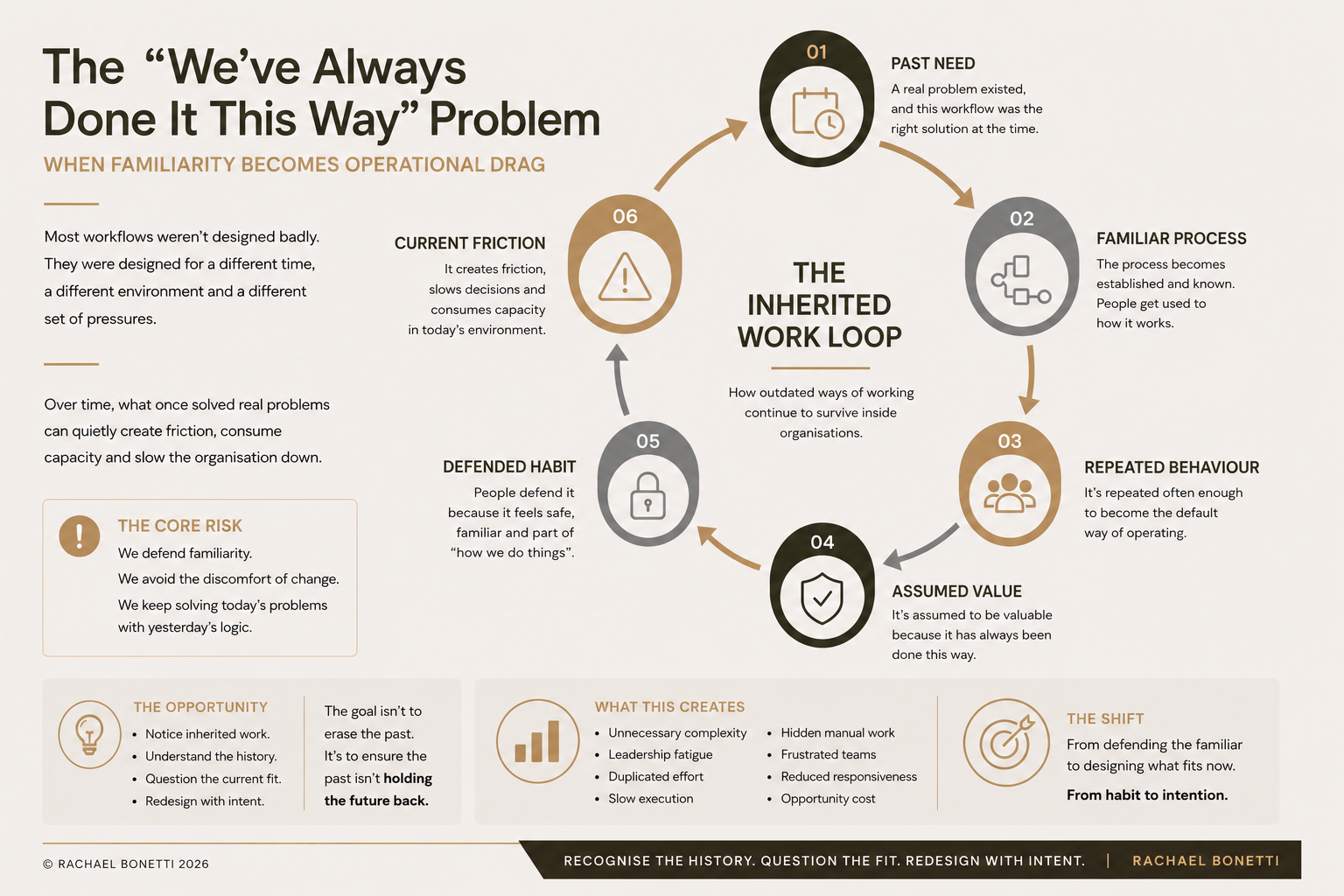
The Inherited Work Loop
This graphic shows how outdated workflows continue surviving inside organisations:
Past need → familiar process → repeated behaviour → assumed value → defended habit → current friction
Many workflows weren’t poorly designed.
They were designed for a different operating environment.
Deployment Tools
Included in this edition:
✔ Inherited Workflow Scan
✔ Pre-Meeting “What Are We Carrying Forward?” Checklist
✔ Executive Conversation Starters
✔ Back-Pocket Confidence Cues
✔ Legacy Assumption Reflection
✔ Track Your Impact Tool
✔ Executive Quick View
Why This Matters
Many organisations are trying to operate at a different speed without fundamentally redesigning how work moves underneath that speed.
Over time, inherited workflows can quietly create leadership fatigue, duplicated effort, unnecessary coordination load and hidden manual work that slows execution more than organisations realise.
Your Opportunity
EAs often sit closest to the friction organisations have learned to normalise.
You may notice where work has become heavier than the outcome requires, where systems depend on invisible compensation, or where inherited routines are being protected more out of familiarity than current value.
That visibility is rare and important.
Ask Yourself
Where am I seeing people defend a workflow, process or expectation they privately know no longer makes sense?
And where might I be compensating manually for systems or habits the organisation has already outgrown?
Next Month
Every edition explores a new theme. Fresh signals, fresh tools and a new lens for showing up strategically in a shifting world of work.
From the Editor
One thing I’ve noticed in organisations recently is how often people defend workflows they privately know no longer make sense.
It's not usually because they’re resistant to change, but because those workflows are usually attached to history, trust, experience or a period of time when the organisation genuinely needed them.
That’s what makes this more complicated than simply identifying inefficiency.
Many organisations are trying to operate at a different speed without fundamentally redesigning how work moves underneath that speed. AI is accelerating production expectations. Teams are leaner. Decision cycles are shorter. Leaders are absorbing larger volumes of information and coordination than they were a few years ago.
But underneath those changes, many organisations are still carrying inherited meeting structures, approval layers, reporting rhythms, communication habits and manual workarounds from earlier operating environments.
And under pressure, people often protect familiar systems because redesigning them properly requires time, trust, political capital and operational space that many teams feel they no longer have.
I think EAs feel this tension acutely.
You’re often the person compensating manually for systems that no longer fit cleanly together. You see the hidden effort required to keep work moving. You notice where process and purpose have drifted apart, where duplication has become normalised, and where leaders are still operating through inherited assumptions that no longer fully match the conditions around them.
The challenge isn't in rejecting institutional knowledge or dismissing history.
It’s recognising when the organisation has started carrying work that no longer serves it in the same way it once did.
— Rachael
1. Market Pulse - Decoded for EA's
Many organisations are now layering AI, automation and productivity initiatives onto workflows that were never redesigned for the pace and complexity of current work.
Here’s the real story you need to hear:
The issue is often not capability. It’s inherited work that no longer matches the environment around it.
This is the ripple effect your executive is already navigating:
- approval pathways slowing momentum
- duplicated reporting and communication
- meeting overload
- manual coordination compensating for fragmented systems
- outdated KPIs shaping current decisions
- leaders absorbing unnecessary operational detail
- teams maintaining workflows nobody has had time to rethink properly
Here's the opportunity for you
EAs often see where organisations are compensating for inherited friction.
You may notice:
- work that depends heavily on chasing and follow-up
- meetings that survive mostly because they always have
- reports produced out of expectation rather than usefulness
- manual workarounds covering process gaps
- AI layered onto workflows that should have been questioned first
- leaders carrying operational load that stronger systems should absorb
That visibility creates strategic value.
Not because every issue becomes your responsibility to fix, but because recognising the pattern is often the beginning of more intelligent conversations.
It's also one of the most highly valued strategic EA skills right now.
Stretch yourself here
Before identifying a workflow as outdated, ask:
What problem was this originally designed to solve?
That question creates a much more thoughtful starting point than assuming the process exists for no reason.
Back-pocket confidence cue
- “I wonder whether this process still reflects the way the work is moving now.”
- “This may have solved an important problem originally, but the surrounding conditions seem to have shifted.”
- “I’m noticing this workflow now depends heavily on manual intervention.”
- “It may be worth reviewing whether this process is still reducing enough risk to justify the friction it creates.”
- “This feels less like a broken process and more like a process the organisation may have outgrown.”
- “Before we automate this further, it may help to revisit whether the workflow itself still makes sense.”
2. Decoded Visual Snapshot
What the signal is showing
Inherited workflows often survive because organisations adapt around them rather than redesign them.
Over time:
- people compensate manually
- workarounds become normalised
- friction gets absorbed quietly
- duplication becomes invisible
- leaders stop questioning inherited structures because the organisation still appears functional
But functionality is not the same as fit.
AI is now exposing many of these inherited inefficiencies because automation forces organisations to confront how work actually moves.
Decoded Takeaway
Automating inherited friction does not remove it. It often scales it.
3. Strategic Implications
- AI is making inherited inefficiencies harder to ignore because it exposes where manual coordination is holding workflows together.
- Organisations often defend familiar work because familiarity feels lower-risk than redesign.
- EAs are frequently compensating manually for systems, processes and communication structures that no longer fit current conditions.
- Long-tenured employees may feel protective of inherited workflows because those workflows hold institutional memory and identity.
- The strongest organisations will not simply add new capability. They will rethink which inherited work still deserves to exist.
4. What Headlines Aren't Saying
The public conversation around AI tends to focus on what organisations can now do faster.
But speed is only one part of the equation.
Many organisations are discovering that layering AI onto inherited workflows does not necessarily create better work. Sometimes it simply accelerates outdated logic, duplicated effort or inefficient process design.
That’s why the HBR article behind this edition is so relevant. Its central argument is that organisations are often constrained less by missing capability than by outdated assumptions and inherited workflows that continue shaping decisions long after conditions have changed.
For EAs, this becomes highly visible in day-to-day work.
You often see:
- where process has drifted away from purpose
- where systems rely on invisible manual compensation
- where leaders are carrying coordination load unnecessarily
- where teams privately acknowledge friction but publicly defend the process
- where work continues because questioning it feels more difficult than maintaining it
There is also a deeply human layer to this.
People don’t only defend workflows because they believe they’re effective. They may defend them because those workflows represent:
- expertise
- history
- control
- consistency
- risk management
- familiarity
- institutional memory
- decisions made by respected leaders
That’s why changing inherited work requires sensitivity as well as insight.
What This Means For You as an EA
Your role often places you in direct contact with the hidden effort organisations use to maintain inherited systems.
You may be:
- manually stitching fragmented workflows together
- compensating for unclear ownership
- translating between disconnected teams
- carrying institutional memory that systems don’t hold
- chasing approvals that no longer need to exist
- protecting continuity where process no longer provides it naturally
That work is often invisible.
But it also gives you unusually clear visibility into where the organisation may have outgrown the way work currently happens.
Stretch Yourself Here
When you notice friction, resist the urge to jump immediately into fixing it.
Instead ask:
- What is this process protecting?
- What risk does it still reduce?
- What has changed around it?
- Who feels ownership over it?
- What hidden manual effort is currently keeping it functional?
- What would happen if it stayed exactly the same for another two years?
Those questions often reveal more than the workflow itself.
EA Conversation Starters
For Strategic Briefings
“I’m noticing a few areas where inherited ways of working may no longer match the pace or shape of the work now.”
For Planning Sessions
“Where are we compensating manually for workflows the organisation may have already outgrown?”
For Stakeholder Updates
“It may help to separate what’s historically important from what’s operationally necessary today.”
Back-Pocket Confidence Cues
- “I don’t think the original process was wrong. I think the surrounding conditions may have changed.”
- “This may be a case of the organisation adapting around friction rather than redesigning it.”
- “It could be useful to revisit the purpose before adding more process or automation.”
5. EA Influence Moves
This edition becomes practical when EAs stop viewing inherited friction as simply “the way things are.”
Senior influence often begins with recognising where the organisation is compensating manually for workflows, assumptions or coordination structures that no longer fit cleanly together.
That doesn’t mean trying to redesign everything yourself.
It means becoming more intentional about noticing:
- where hidden effort exists
- where manual compensation has become normalised
- where old assumptions continue shaping current decisions
- where familiar work is quietly consuming leadership attention and team capacity
Leverage Points
Strategic (C-suite)
In a senior EA, business partner or junior Chief of Staff-style role, your leverage may sit in helping leadership notice:
- where inherited reporting rhythms are creating unnecessary coordination load
- where manual workflows are consuming disproportionate executive attention
- where AI is exposing outdated process design
- where old assumptions are shaping current priorities
- where familiar work is being protected despite visible friction
- where redesign conversations require political sensitivity because of the history attached to the workflow
Practical (Non-C-suite)
In a more traditional support role, your leverage may sit in noticing:
- repeated manual follow-up
- duplicated communication
- unnecessary approval steps
- recurring workarounds
- meetings that no longer support decision-making effectively
- reports that create effort without improving visibility
- process friction people have stopped questioning
You may not own the redesign, but you are often close enough to see where the organisation is carrying operational weight unnecessarily.
Stretch Yourself
Look for one area this month where the organisation appears to be compensating manually for inherited friction.
Rather than immediately solving it, spend time understanding:
- why it exists
- what it once protected
- who relies on it
- what conditions have changed around it
That level of understanding usually leads to far better conversations.
6. Practical Deployment Tools
EAs don’t just need insight. They need tools they can use when conditions are moving and clarity is partial.
These tools are designed to help you notice inherited work thoughtfully, understand the conditions surrounding it and approach workflow friction with greater strategic maturity.
A. Pre-Meeting Checklist
Before your next leadership meeting, run this five-minute scan:
- Which recurring workflow feels heavier than the value it creates?
- Where is manual coordination compensating for system gaps?
- Which meetings or reports survive mainly through habit?
- What assumptions continue shaping decisions despite changing conditions?
- Where might AI accelerate an inefficient process instead of improving it?
- What friction has become so normalised people no longer question it?
- What respectful question could open the conversation constructively?
B. Email Scripts & Talking Points
- “I wonder whether this process still reflects the way the work is moving now.”
- “This may have solved an important problem originally, but the surrounding conditions appear to have shifted.”
- “Before we layer more automation onto this, it may help to revisit whether the workflow itself still serves the intended outcome.”
- “I’m noticing this process now depends heavily on manual follow-up and workarounds.”
- “It may be useful to separate the historical purpose of the workflow from what the organisation currently needs.”
These talking points help raise inherited work as a thoughtful operational observation rather than criticism of the people who created or maintained it.
C. Conditional Clarity Tool
Refer back to Edition 6’s Conditional Clarity Tool.
Inherited workflows often survive because nobody has clearly named what conditions have changed around them.
Use this tool to explore:
- what assumption may no longer hold
- what risk the process still reduces
- what hidden effort now keeps it functioning
- whether the workflow still matches the current environment
D. Conditional Decision Log
Refer back to Edition 6’s Conditional Decision Log.
Inherited friction rarely reveals itself through one moment. It becomes visible through repeated patterns over time.
Use the log to track:
- repeated delays
- recurring manual intervention
- duplicated communication
- increasing workarounds
- workflow friction that continues despite “successful” execution
D. Track Your Impact
Use this tracker to capture:
- where you identified inherited friction
- where you raised a respectful operational question
- where you reduced hidden manual effort
- where you improved visibility into workflow strain
- where your observation prevented unnecessary complexity
- where you helped separate historical habit from current business need
7. Executive Ready Notes
Theme: The “We’ve Always Done It This Way” Problem
When you only have a few minutes to prepare, this is your shortcut.
A one-page executive-level summary designed to help you think through:
- inherited workflows
- operational drag
- hidden manual compensation
- outdated assumptions
- AI and process acceleration
- respectful ways to question existing work
DOWNLOAD: EXECUTIVE READY NOTES
8. Using The Brief with Care
For maximum impact, avoid treating inherited workflows as automatically outdated or inefficient.
Many processes, approval structures and habits were created to solve real problems at important moments in the organisation’s history.
Apply judgement before challenging them.
Consider:
- what the workflow originally protected
- who feels ownership over it
- what risk it still reduces
- whether the timing is right for the conversation
- whether the issue is systemic or situational
- whether you are seeing a pattern or reacting to frustration
- whether the organisation currently has capacity for redesign
The aim is not to dismiss institutional memory.
It’s to recognise where inherited work still serves the organisation and where it may now be creating more operational weight than value.
9. Urgency
This edition matters now because many organisations are accelerating work without fully redesigning how work happens underneath that acceleration.
That creates a growing risk:
- AI speeding up inefficient workflows
- leaders carrying unnecessary coordination load
- hidden manual work increasing quietly
- teams compensating for outdated systems
- friction becoming so normalised it disappears from discussion
EAs often feel those tensions earlier than most and that visibility matters.
10. Go Deeper: Curated Reading & Listening
Suggested anchor reading:
HBR: 3 Ways AI Can Free Organizations from Legacy Workflows by Graham Kenny and Ganna Pogrebna.
11. Audio Briefing
Prefer to listen instead of read?
Each month, you’ll also find a short audio briefing from me. Think of it as a five-minute download: the context behind this edition, the shifts worth paying attention to, and the lens to carry into your thinking this month.
This month’s audio briefing covers:
- why organisations often continue carrying workflows they’ve already outgrown
- the hidden operational cost of inherited work
- why pressure makes familiar systems harder to challenge
- how AI is exposing inefficient workflows many organisations previously absorbed manually
- why EAs often feel organisational friction before it becomes formally acknowledged