Theme: The Insight That Doesn't Reach The Room
What accelerated organisations risk when operational truth gets softened, delayed or lost.
What's Inside
Market Pulse
Across industries, organisations are under pressure to move faster, operate leaner and integrate AI into operational workflows while maintaining execution quality, stakeholder confidence and commercial performance.
In these environments, communication often becomes more compressed, polished and outcome-focused. At the same time, a number of recent organisational failures and public controversies have raised broader questions about escalation, information quality, internal challenge and whether operational concerns were surfaced clearly enough, early enough, or taken seriously enough when they were.
Global signals decoded:
The signal isn't simply that people are afraid to speak up.
It's that accelerated environments can unintentionally chnage how information moves through organisations.
Under pressure:
- concerns may be softened
- updates become more polished
- uncertainty gets edited out
- teams protect momentum
- operational friction is normalised
- leaders receive cleaner narratives than operational reality may support
This isn’t always deliberate.
But it changes decision quality.
Recent examples across industries — including governance failures, rollout breakdowns, AI-related reputational damage and operational crizqses — point to a broader tension many organisations are navigating right now:
How do leaders maintain access to useful operational truth when speed, complexity and pressure are increasing?
Overlooked Risk
When operational insight gets filtered too heavily on its way upward, organisations can lose access to the early signals that help leaders make stronger decisions before problems compound.
Framework Snapshot
The information Gap
This graphic shows the widening gap that can emerge between operational reality and leadership visibility in high-pressure environments.
The larger the gap becomes, the harder it is for leaders to respond to issues early, accurately and proportionately.
Deployment Tools
Included in this edition:
✔ Operational Insight Reflection Tool
✔ Leadership Visibility Scan
✔ Psychological Safety Reflection Questions
✔ Meeting & Briefing Contribution Prompts
✔ Communication Framing Examples
✔ Executive Quick View
✔ External Frameworks & Further Reading
Executive Quick View
A one-page summary for you to review quickly when preparing for meetings with your executive.
Includes:
- why information quality matters more in accelerated environments
- what happens when operational truth becomes overly filtered
- where EAs often hold visibility others do not
- practical ways to contribute insight thoughtfully
- the role judgement, timing and trust play in surfacing concerns well
Why This Matters
EAs often sit at the intersection of leadership expectations and operational reality.
You notice hesitation, softened language, recurring workarounds, over-polished updates and the operational strain that may not fully reach formal reporting lines.
In pressured environments, that gap matters.
Because leaders can only make decisions based on the quality of information reaching them.
And increasingly, organisations are operating under conditions where information can become compressed, edited or oversimplified in the pursuit of speed, alignment or momentum.
Your Opportunity
Your role gives you proximity to patterns, tensions and operational signals that may not always be visible from the top of the organisation.
That does not mean carrying responsibility for every issue.
But it does mean your judgement, observations and questions can help strengthen the quality of information, discussion and decision-making around leadership.
Ask Yourself
Where am I noticing hesitation, over-polished communication or incomplete truth-telling within the broader team environment?
And where might pressure, hierarchy, speed or fear of being difficult be shaping what reaches leadership?
Next Month
Every edition explores a new theme. Fresh signals, fresh tools and a new lens for operating thoughtfully in a changing world of work.
From the Editor
Over the past few months, I’ve found myself paying closer attention to how information moves inside organisations under pressure.
Not the formal reporting structures but more, the subtle shifts that happen around them:
- The operational concern that gets reframed into something more manageable before it reaches leadership.
- The hesitation before someone raises a challenge in a meeting.
- The update that sounds technically accurate but somehow incomplete.
- The growing tendency for teams to compress nuance in the interest of speed, alignment or momentum.
I don’t think most organisations do this consciously.
In many ways, it’s a predictable response to the conditions people are working under. Teams are leaner. Expectations are higher. Communication cycles are faster. AI is accelerating production and increasing pressure for responsiveness across many environments.
At the same time, leaders are absorbing larger volumes of information and making decisions in increasingly compressed timeframes.
In those conditions, information can start changing shape as it moves upward through the organisation.
Not necessarily through dishonesty, but through caution, simplification, uncertainty about what matters, or a desire not to create friction in already stretched environments.
This matters because decision quality is only ever as strong as the visibility leaders have into what is actually happening operationally.
I think EAs sit unusually close to this dynamic.
You often have visibility across leadership conversations, team sentiment, stakeholder behaviour and operational friction in ways that are not always formally acknowledged, but are highly significant.
You may notice when communication feels overly polished, when concerns are repeatedly softened, or when teams appear reluctant to raise difficult information early.
That doesn't mean every observation requires escalation, but I do think it changes how we should think about the influence of the EA role inside increasingly pressured organisations today.
This edition explores that tension.
— Rachael
1. Market Pulse - Decoded for EA's
Many organisations are now operating in environments where speed, responsiveness and output are heavily rewarded.
Here’s the real story you need to hear:
In accelerated environments, the quality of information reaching leadership can quietly degrade long before anyone recognises there is a problem.
This is the ripple effect your executive is already navigating:
- teams protecting momentum over nuance
- concerns raised later than they should be
- updates becoming increasingly polished
- operational strain hidden beneath performance
- communication shaped by pressure rather than clarity
- people avoiding friction in already stretched environments
- leadership receiving filtered visibility
Here's the opportunity for you
EA's often hold a broader view across leadership, teams and workflows than people realise.
That position can help you:
- recognise patterns early
- identify when communication feels incomplete
- sense when teams are withholding concerns
- notice when operational pressure is changing behaviour
- strengthen the quality of conversations around leadership
Not through authority, through proximinity, discrenment and judgement.
Stretch yourself here
Pay attention to the difference between:
- what is formally communicated
- what is implied
- what is repeatedly avoided
- what people say privately but hesitate to say publicly
The gap between those things can become highly significant over time
Back-pocket confidence cue
- “I may be wrong, but I think there’s a broader pattern sitting underneath this.”
- “I’m noticing some hesitation around this topic that may be worth exploring further.”
- “The updates sound positive, but I think there may still be unresolved operational pressure underneath them.”
- “I wonder whether we’re getting the full picture yet.”
- “There may be value in slowing this conversation down slightly before decisions are finalised.”
- “I think part of the risk here may be what isn’t being surfaced yet.”
2. Decoded Visual Snapshot
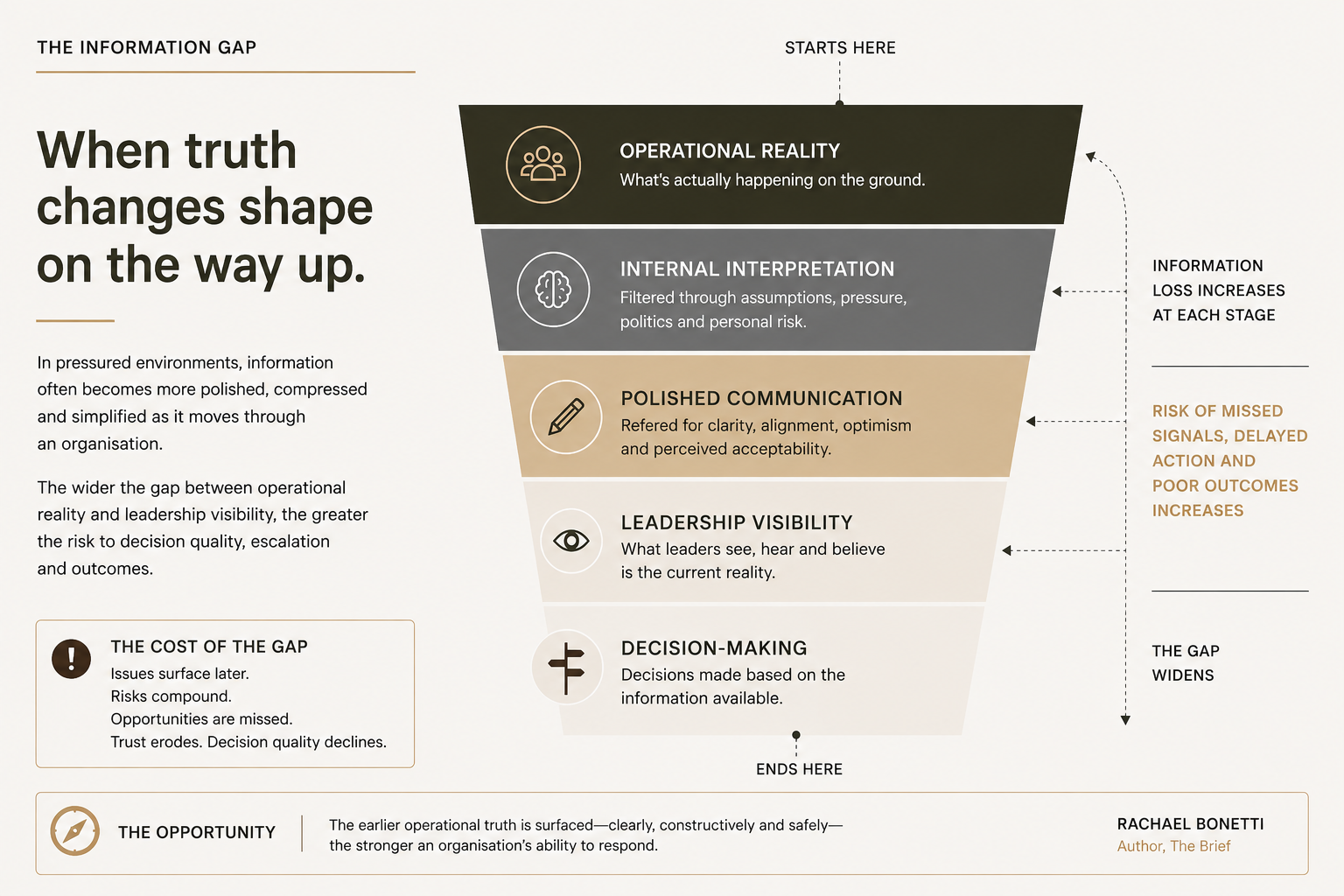
What the signal is showing
In pressured organisations, communication often becomes more refined as risk increases, not less:
- People soften concerns.
- Compress nuance.
- Protect relationships.
- Avoid becoming the blocker.
- Edit uncertainty out of updates.
- Delay difficult conversations until there is more certainty.
Meanwhile leaders continue making decisions based on the information available to them.
Decoded Takeaway
The earlier operational truth can be surfaced constructively, the stronger an organisation’s ability to respond becomes.
3. Strategic Implications
- Accelerated environments can unintentionally discourage nuance, dissent and uncertainty.
- Leaders may not realise how much information has been filtered before it reaches them.
- Psychological safety is not simply cultural. It directly affects decision quality, escalation and operational visibility.
- EAs often have visibility across communication layers that others inside the organisation do not.
- The value of discernment is increasing as information environments become faster and more compressed.
4. What Headlines Aren't Saying
Many headlines frame organisational failures as governance problems, leadership failures or execution breakdowns.
But beneath many of those stories sits another question:
What information failed to travel upward clearly enough, early enough or safely enough?
In recent years, we’ve seen examples across industries where organisations appeared highly functional externally while operational strain, internal concern or execution risk sat underneath the surface for longer than they should have.
That matters because pressured environments can unintentionally reward:
- confidence over caution
- speed over reflection
- certainty over nuance
- alignment over challenge
Over time, that changes what reaches leadership.
For EAs, this is an important lens.
Because you often sit close enough to notice:
- what gets softened
- what gets delayed
- what people are hesitant to raise
- where teams are managing perception carefully
- when operational reality and leadership visibility begin drifting apart
That doesn’t mean escalating every concern, but it does mean recognising the value of thoughtful operational insight.
What This Means For You as an EA
Your role gives you visibility into:
- communication flow
- stakeholder dynamics
- meeting behaviour
- leadership pressure
- operational hesitation
- recurring friction
- what people are comfortable saying publicly versus privately
That visibility can help you contribute to stronger conversations and better-informed leadership environments when used thoughtfully.
Stretch Yourself Here
Before raising a concern, observation or pattern, ask yourself:
- What have I actually observed?
- What assumptions might I be making?
- Is this isolated or recurring?
- What conditions may be influencing behaviour here?
- What is the risk of saying nothing?
- What is the safest constructive way to raise this?
EA Conversation Starters
For Strategic Briefings
“I’m noticing a few signals that may suggest there’s more operational pressure underneath this than is currently visible.”
For Planning Sessions
“Where might we unintentionally be creating conditions where concerns become harder to raise early?”
For Stakeholder Updates
“One thing worth watching may be the gap between reported progress and operational strain underneath delivery.”
Back-Pocket Confidence Cues
- “I don’t think this is necessarily resistance. I think there may be hesitation underneath it.”
- “This may be less about the issue itself and more about the conditions around it.”
- “I’m not certain yet, but I think there may be value in testing this signal further before moving past it.”
5. EA Influence Moves
This edition is intended to recognise that many EAs already influence the quality of information, discussion and decision-making around leadership every day.
Sometimes through:
- the questions you ask
- the context you provide
- the timing of a conversation
- what gets prioritised
- what gets revisited
- how information is framed
- whether nuance is protected or compressed
That influence can become especially important in fast-moving environments where leaders are receiving increasingly condensed versions of operational reality.
Leverage Points
Strategic (C-suite)
Senior EAs may influence:
- the quality of context reaching leadership
- whether nuance survives escalation pathways
- how concerns are framed and surfaced
- whether difficult conversations happen early enough
- the conditions around strategic discussion
- whether leaders have access to fuller operational visibility
Practical (Non-C-suite)
EAs in more traditional support environments may influence:
- whether uncertainty gets clarified early
- how accurately updates are communicated
- whether quieter voices are included
- how concerns are captured in meetings
- whether recurring friction becomes normalised
- the quality of information flowing between stakeholders
Stretch Yourself
Not every insight needs escalation, but some observations deserve more attention than organisations initially give them.
Learning to distinguish between the two is part of developing mature operational judgement.
6. Practical Deployment Tools
EAs don’t just need insight. They need frameworks that help them think carefully about communication, judgement and contribution in environments where pressure, hierarchy and timing all matter.
A. Leadership Visibility Scan
Before your next leadership meeting, ask yourself:
- What concerns may still be under-discussed?
- Where does communication feel overly polished?
- What operational strain may not be fully visible yet?
- Who has not contributed perspective recently?
- What topics seem repeatedly deferred?
- Where might speed be reducing reflection quality?
- What questions could improve visibility without escalating unnecessarily?
B. Communication Framing Examples
- “I may not have the full picture yet, but I think there’s a pattern worth paying attention to.”
- “I wonder whether there’s additional operational context underneath this update that would be useful to explore.”
- “There may be value in pressure-testing this before moving too quickly.”
- “I’m noticing some hesitation around this topic that may be worth understanding better.”
- “I think part of the challenge here may be the conditions around the issue, not only the issue itself.”
These examples help create space for discussion without overstating certainty or escalating unnecessarily
C. Track Your Impact
Use this reflection tracker to note where your judgement, questions or observations helped:
- surface operational nuance
- improve leadership visibility
- create space for fuller discussion
- strengthen decision quality
- identify risks earlier
- improve communication clarity
- reduce misunderstanding between stakeholders
D. Further Reading & Practical Frameworks
For readers wanting to explore how organisational pressure, communication behaviour and workplace conditions interact, the Victorian WorkSafe psychosocial risk resources offer a useful systems-level lens. Access the free resources here:
WorkSafe Victoria Psychosocial Risk Management Resources
Rather than viewing psychological safety purely through a wellbeing lens, I’d encourage you to read these resources through an operational lens as well:
- How do workplace conditions shape communication?
- What happens to escalation patterns under pressure?
- How does workload or pace affect decision quality?
- What becomes harder for people to raise in stretched environments?
7. Executive Ready Notes
Theme: The Insight That Doesn’t Reach the Room
When you only have a few minutes to prepare, this is your shortcut.
A one-page executive-level summary designed to help you contribute thoughtfully to conversations around organisational pressure, escalation, communication quality and operational visibility.
DOWNLOAD: EXECUTIVE READY NOTES
8. Using The Brief with Care
Psychological safety isn't created by simply encouraging people to speak openly.
It's shaped by whether people believe nuance, uncertainty and difficult information can be raised without disproportionate personal, political or professional cost.
Use this edition with judgement.
For maximum impact, avoid:
- treating every observation as something that must be escalated
- confusing frustration with operational insight
- assuming your visibility is complete
- bypassing trust, timing or confidentiality
- positioning interpretation as fact
- raising concerns publicly when a quieter conversation may be more constructive
- expecting candour in environments where people have learned caution through experience
Read the environment carefully.
Consider the organisational history.
Protect trust.
And remember that mature judgement isn't only about recognising what matters.
It's also about recognising how, when and whether a conversation can be safely received.
9. Urgency
This matters now because many organisations are operating under increasing pressure while simultaneously accelerating pace, compressing communication and integrating AI into operational workflows.
In these conditions, the quality of information reaching leadership becomes even more important.
The risk isn’t simply silence.
The risk is distortion:
- softened concerns
- delayed escalation
- compressed nuance
- filtered operational visibility
EAs often sit close enough to notice those shifts before they become formally visible.
That proximity matters.
10. Audio Briefing
Prefer to listen instead of read?
Each month, you’ll also find a short audio briefing from me. Think of it as a five-minute download: the context behind this edition, the shifts worth paying attention to, and the lens to carry into your thinking this month.
This month’s audio briefing covers:
- why accelerated environments can subtly change communication behaviour
- the hidden organisational cost of over-polished information
- what happens when operational truth becomes softened or delayed
- why EAs often sit unusually close to early organisational signals
- the difference between reacting emotionally and contributing insightfully
- how judgement, timing and trust shape whether information can actually be heard
- the lens I’d encourage you to carry into conversations this month