Theme: The shift from doing the work to designing it.
From the Editor
We’re operating in a different environment now.
It’s not just faster. It’s more digital, more unstable, more expensive, and far less predictable.
Over the past few months, global tension, rising energy costs, and shifting alliances have reinforced something many organisations are already feeling. The conditions they’re operating in are no longer steady. They move, and they move quickly. We’ve explored this in earlier editions of The Brief (explore the back catalogue if you’re new here).
In that kind of environment, performance becomes less about effort and more about how well work is structured.
Pushing harder doesn’t solve for volatility but designing work differently does.
That’s why we’re seeing growing attention on how work actually runs inside organisations. Not just what gets done, but how it flows, how decisions are made, and how outcomes are delivered under pressure.
Agentic AI is one expression of this shift. It’s not the whole story, but it is a clear signal. Work is starting to move from something people complete to something that is designed, structured, and increasingly run through systems.
Which changes where value sits.
Execution becomes easier to compress.
Judgement, structure, and direction become more important.
Executive Assistants and Chiefs of Staff are at the centre of this.
This edition is about understanding that shift at a practical level. What it means, where it’s showing up, and how to step into it in a way that is useful, not theoretical.
Because the people who can see how work should run, not just how to get it done, will shape what comes next. This is emerging as the competitive edge.
— Rachael
Market Pulse
Global signals decoded:
Rising geopolitical tension, unstable energy markets, and sustained cost pressure are forcing organisations to operate in more volatile conditions. At the same time, leaders are under growing pressure to show return on AI investments, shifting the focus from experimentation to measurable performance.
Overlooked Risk
Many organisations are layering AI onto existing ways of working rather than redesigning workflows. Without structural change, this limits ROI, slows execution, and reinforces inefficiency under pressure.
1. Market Pulse - Decoded for EA's
This isn’t just more AI conversation. It’s a shift in how work is being structured inside organisations.
Here’s the real story you need to hear:
Work is moving from something people complete to something that is designed, structured, and increasingly run through systems.
This is the ripple effect your executive is already navigating:
- Pressure to demonstrate ROI on AI investments, not just adoption
- Expectation to deliver more output without increasing cost
- Shorter cycles for decisions, delivery, and execution
- Greater scrutiny on where time, effort, and resources are being spent
- A growing gap between teams that are redesigning work and those still operating as before.
Here's the opportunity for you
You sit close enough to the work to see how it actually runs, not just how it’s supposed to run.
That puts you in a position to:
- identify where effort is being wasted
- spot where work could be structured differently
- contribute to conversations about how workflows could improve
- help shape how AI and automation are applied in a practical way
You don’t need to own the technology to be part of this shift but you do need to understand how it works in practice.
In many organisations, early exploration of AI in workflows is already happening, often within small teams or informal pilots. Some organisations are already embedding AI agents on their org charts (and referring to org charts as Work Charts to better capture the shift).
Being able to contribute to those conversations, even at a conceptual level, is becoming part of staying relevant.
Stretch yourself here
Start shifting your lens from:
- “What needs to be done?”
to
- “How is this actually running, and could it run better?”
Look for:
- repeated follow-ups or chasing
- unclear ownership or handovers
- tasks that rely on memory rather than structure
- processes that feel heavier than they should
If you haven’t yet explored how AI could support a workflow you’re involved in, this is the moment to start. Not to implement, but to understand what would need to change for it to work.
Back-pocket confidence cue
- “There may be an opportunity to look at how this workflow is structured, not just how quickly we can get it done.”
- “If we mapped this end to end, I suspect we’d find a few points where time is being lost.”
- “This feels like something that could run with clearer inputs and defined checkpoints.”
- “We might be solving this manually when it could be structured to run more consistently.”
- “If we’re looking for ROI from AI, the workflow probably needs to be considered alongside the tool.”
- “This looks like a candidate for redesign rather than optimisation.”
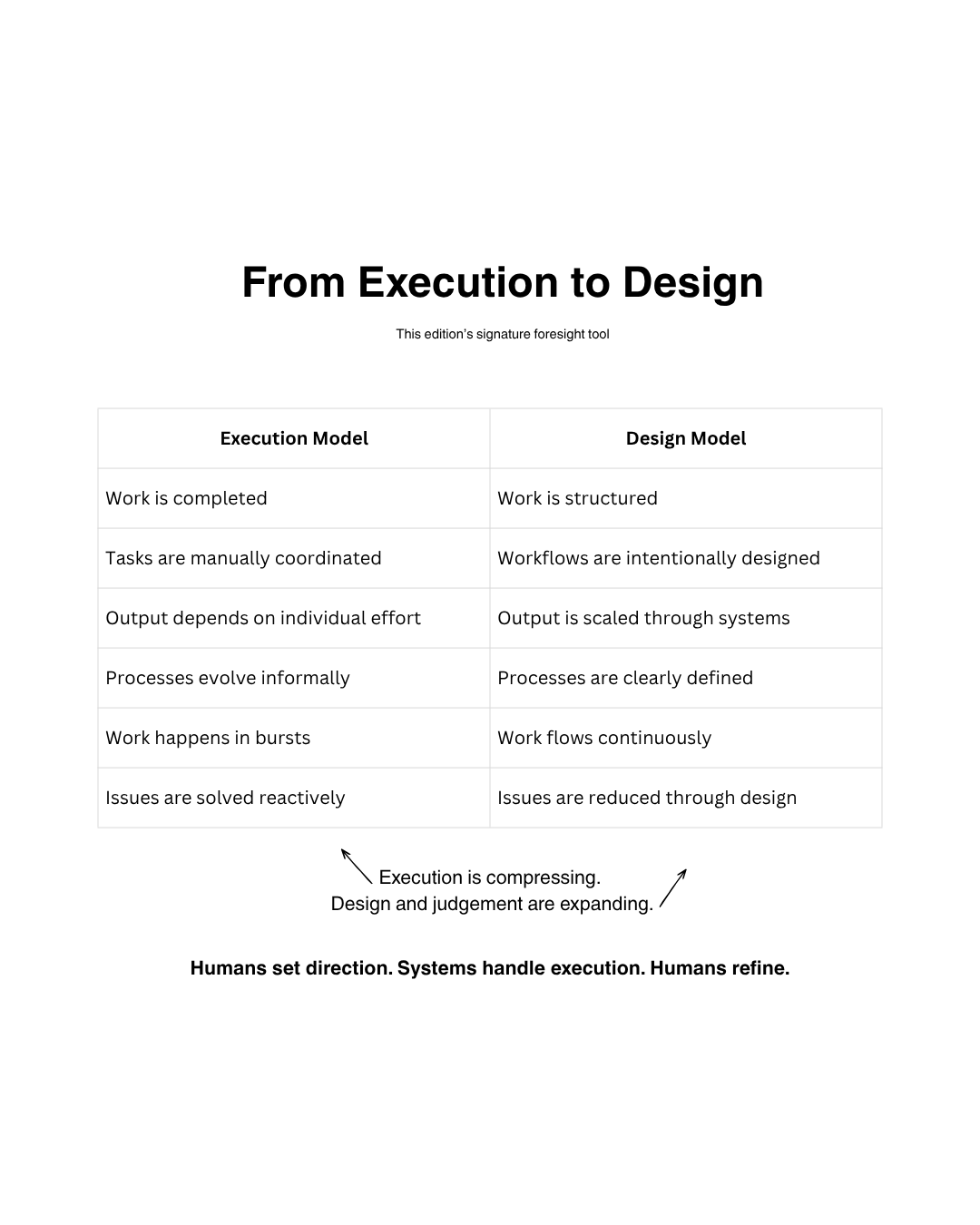
2. Decoded Visual Snapshot
What the signal is showing
Work is no longer organised around people completing tasks from start to finish.
It is increasingly being structured as a system:
- where inputs are defined
- steps are sequenced
- parts of the work can run independently
- and outputs are reviewed, refined, and redirected
Agentic AI is one visible example of this model.
In these environments:
- humans set intent, structure the work, and define what “good” looks like
- systems and agents execute tasks, test, iterate, and produce outputs
- humans step back in to assess quality, adjust direction, and improve the system over time
The shift isn’t about replacing people. It’s about redistributing where effort and thinking sit in the workflow.
This is the model leaders are starting to optimise for, whether it’s explicitly named or not.
Decoded Takeaway
Execution is compressing. Design and judgement are expanding.
3. Strategic Implications
- AI will not deliver meaningful returns without workflow redesign
Most organisations are still applying AI at task level. The real gains sit at workflow level. Without rethinking how work is structured end-to-end, improvements remain incremental and ROI remains unclear. - Execution capacity is no longer the primary constraint
As parts of work become easier to automate or distribute, the limiting factor shifts to how well work is defined, sequenced, and directed. Poorly structured work will slow down even high-capability teams. - Operating models will shift before roles formally change
Expectations around speed, output, and responsiveness are already increasing. In many organisations, the way work runs is changing faster than job descriptions or formal responsibilities. - The gap between leveraged and non-leveraged work is widening.
Teams that redesign workflows will deliver more with less effort. Those that continue to rely on manual coordination and reactive processes will feel increasing pressure, even if they are working harder. - Judgement and context become the control layer.
As more execution is handled by systems or distributed across teams, value sits in setting direction, defining boundaries, and ensuring outputs align with intent. This is where quality, risk, and performance are managed. - AI adoption will expose weak processes, not fix them.
When workflows lack clarity, structure, or defined outcomes, AI amplifies inconsistency rather than resolving it. The organisations seeing the strongest results are those that invest in how work is designed, not just which tools are used. - Exploration is becoming part of operational readiness.
Organisations don’t need everyone to be technical, but they do need people who can engage with how AI could apply to real workflows. Those who can’t contribute to that conversation risk being excluded from it. - Designing work requires a different level of thinking.
It demands clarity, structure, and anticipation. This is harder than completing tasks, which is why many organisations default back to execution even when better models exist.
4. What Headlines Aren't Saying
What sits beneath the headlines
-
AI doesn’t remove work. It redistributes it.
Execution may reduce in some areas, but the need for structure, coordination, and oversight increases. Work doesn’t disappear. It shifts. -
AI ROI is not a tool problem. It’s a workflow design problem.
-
Most organisations are not redesigning work. They’re layering AI on top of it.
This creates friction, not flow. Tools are introduced, but workflows remain fragmented, manual, and dependent on individual effort. -
The real constraint is not technology. It’s how clearly work is defined.
AI systems rely on structured inputs, defined outcomes, and clear boundaries. Where these don’t exist, performance drops and outputs become inconsistent. -
ROI is being measured, but the wrong things are often tracked.
Adoption rates and usage metrics are easy to report. Meaningful gains sit in reduced cycle time, improved quality, and better flow across teams. - The shift is less about capability and more about operating discipline.
The organisations seeing progress are not necessarily, more advanced technically. They are more deliberate about how work is structured, measured and improved.
What this means for you as an EA
Your value is not in doing more work faster.
It sits in:
- creating structure where there is ambiguity
- defining how work should move, not just responding to it
- ensuring inputs, outputs, and expectations are clear
- maintaining flow across people, priorities, and systems
You are already working at the intersection of:
- information
- decisions
- execution
This shift increases the importance of that position.
Stretch Yourself Here
Start stepping back from individual tasks and looking at the system they sit within.
Instead of asking:
- “What needs to happen next?”
Ask:
- “Where does this process break down?”
- “What is causing the back-and-forth here?”
- “What would make this run without intervention?”
- “If this scaled, where would it fail?”
EA Conversation Starters
For Strategic Briefings
“We’re seeing pressure on speed and output. It may be worth looking at where workflows are slowing us down, not just where workload is high.”
For Planning Sessions
“If we were designing this process now, would we structure it the same way, or are we working around legacy steps?”
For Stakeholder Updates
“There are a few areas where effort is repeating. There may be an opportunity to streamline how this runs.”
Back-Pocket Confidence Cues
- “This feels like a workflow issue rather than a capacity issue.”
- “We might get more impact by simplifying how this runs rather than adding more to it.”
- “There’s likely an opportunity to reduce effort here by tightening the structure.”
5. EA Influence Moves
How this edition becomes practical
If no one is actively shaping how work runs, the default is inefficiency.
This shift doesn’t require you to change roles. It requires you to change how you see and approach the work in front of you.
Instead of focusing only on:
- getting things done
- keeping things moving
You begin to:
- shape how work flows
- reduce unnecessary effort
- create conditions where things run more smoothly without constant intervention
That is where influence starts to build.
Leverage Points
Strategic (C-Suite)
Direction:
Improve how recurring work runs so it requires less effort and creates more consistency.
Focus on:
- simplifying processes that feel heavier than they should
- reducing duplication and unnecessary steps
- creating clearer structure for tasks that rely on memory or chasing
- improving handovers so work flows more cleanly between people
Small changes here compound quickly
Stretch Yourself
Choose one area of work you touch regularly.
Map it simply:
- what triggers it
- who is involved
- where it slows down
- where effort is repeated
Then ask:
“If this needed to run faster, with less effort, what would need to change?”
You're not looking for a perfect answer, you're building the habit of seeing work differently.
6. Practical Deployment Tools
EAs don’t just need insight. They need ways to work with it when conditions are shifting and clarity is partial.
These tools are designed to help you:
- see how work is actually running
- question it in a structured way
- and explore how it could be redesigned, including where AI could play a role
You’re not expected to implement solutions, but you are expected to understand what is possible and where it could apply.
A. Pre-Meeting Checklist
Before your next leadership meeting, run this five-minute scan:
Look for signals of pressure and inefficiency:
- Where are conversations repeating without resolution?
- Where does work seem to slow down or stall?
- Where is ownership unclear or shifting?
- Where are decisions delayed due to missing context?
- Where is effort being duplicated across people or teams?
- Where are processes relying on follow-ups or chasing?
- Where does work feel heavier than it should be?
You are not solving these in the moment - you're learning to read the system.
B. Email Scripts & Talking Points
Use these to introduce ideas without overstepping.
1. Raising a workflow observation
“I’ve been looking at how this is currently running, and there may be an opportunity to simplify or structure it differently to reduce turnaround time.”
2. Linking to efficiency and ROI
“If we’re looking to get more value from AI or automation here, it might help to consider how the workflow itself is structured.”
3. Highlighting repeated effort
“There are a few points where effort is repeating. It may be worth reviewing how this process is set up.”
4. Suggesting a review without pressure
“It could be useful to map this end to end and see where time or effort is being lost.”
5. Opening the door to redesign
“If we were designing this from scratch today, we might approach it differently.”
What these do:
They position you as thoughtful, commercially aware, and focused on outcomes, not just tasks.
C. Worflow Redesign with Prompt Protocol
Use AI as a thinking partner, not just an assistant
When you don’t yet know how to improve a workflow, you don’t need the answer. You need better thinking around the problem.
This protocol allows you to explore workflows as if you had:
- an operations lead
- a process engineer
- or a product manager
- working through it with you.
Use it to:
- map how work currently runs
- identify inefficiencies and friction
- redesign workflows more effectively
- explore where automation or AI could help
- clarify where your role adds the most value
DOWNLOAD: WORKFLOW REDESIGN PROTOCOL
D. Conditional Clarity Tool
(Refer to Edition 06)
When conditions are shifting, clarity is rarely immediate.
Use this tool to:
- separate what is known from what is evolving
- avoid overreacting to incomplete information
- make more grounded decisions about where to focus
This becomes even more important as workflows become more dynamic
E. Conditional Decision Log
(Refer to Edition 06)
When work is changing, value comes from noticing patterns over time.
Use this to track:
- decisions made under pressure
- how those decisions played out
- where workflows held or broke
Over time, this builds sharper judgement.
F. Track Your Impact
Insight only matters if it translates into outcomes.
Use this to capture where you’ve influenced how work runs:
- Where did you identify inefficiency or friction?
- Where did you help simplify or restructure a process?
- Where did you reduce time, duplication, or back-and-forth?
- Where did you contribute to a better way of working?
This is how your impact becomes visible and measurable.
7. Executive Ready Notes
Theme: The Shift from Doing the Work to Designing It
When you only have a few minutes to prepare, this is your shortcut.
Use this one-page summary to quickly ground yourself in:
- what’s changing
- why it matters
- where opportunities sit
- how to contribute to the conversation
So you can enter the room ready to add value without re-reading the full Brief.
Early exploration of how AI fits into workflows is becoming part of operational readiness.
DOWNLOAD: EXECUTIVE READY NOTES
8. Using The Brief with Care
This isn’t about redesigning everything or pushing change without context.
Apply this with judgement.
Every organisation operates within its own constraints, politics, priorities, and appetite for change. Even where improvement is clearly needed, how you raise it matters. Timing matters. Sponsorship can be important. And in some environments, building buy-in quietly before naming a bigger opportunity will be the smarter move.
Use this edition to:
- step back and understand how work is running
- identify where change could create meaningful improvement
- consider who needs to be involved, informed, or aligned before a
- conversation moves forward
- contribute thoughtfully, with an awareness of the environment around you
The goal is not to bulldoze through with a better idea. It’s to recognise where change would be useful, and to approach it in a way that is commercially aware, politically intelligent, and more likely to land.
9. Urgency
This shift is already underway.
Organisations are being pushed to deliver more, with greater speed and less margin for inefficiency. As expectations rise, how work is structured will matter more than how much effort is applied.
The people who can see where work slows down, where it can be simplified, and how it could run differently will have more influence in how teams operate.
Not because they have authority, because they have perspective
10. Go Deeper: Curated Reading
The AI revolution in software development — McKinsey (Rewired)
This excerpt was the starting point for this edition.
It describes a shift already underway in software development, where AI agents run complex workflows, and humans focus on setting direction, defining boundaries, and evaluating outputs. The result is smaller teams, lower unit costs, and significantly faster cycles from idea to impact.
What stood out isn’t the technology. It’s the redistribution of work.
Across industries, this pattern is beginning to emerge. Execution is being handled differently, and value is moving towards how work is structured, guided, and refined.
This mirrors what I’m already seeing in organisations and hearing in the rooms I train.
The EAs operating at a higher level aren’t waiting for their roles to be redefined. They’re rethinking their role at its core, and where they sit in shaping how work moves, decisions are supported, and outcomes are delivered.
That’s what this edition is exploring.
11. Audio briefing
Prefer to listen instead of read?
Each month, you’ll also find a short audio briefing from me. Think of it as a five-minute download — the context behind this edition, the shifts worth paying attention to, and the lens to carry into your thinking this month.
This month’s audio briefing:
The shift from doing the work to designing it
In this briefing, I walk through:
- why rising cost pressure and instability are forcing organisations to rethink how work runs
- what “designing work” actually looks like in practice
- where agentic AI fits into this shift (and where it doesn’t)
- why some teams are already moving ahead, without making a big deal of it
- and how to start engaging with this in a way that’s useful, not overwhelming