Theme: When Conflict Reshapes Business Conditions
How the Middle East crisis is driving cost pressure, scrutiny and harder operating conditions across organisations globally.
What's Inside
The current Middle East conflict is not just a geopolitical event. It's changing cost structures, risk exposure, and decision-making conditions inside organisations globally.
Market Pulse
Global signals decoded:
Energy disruption, restricted movement, and shifting alliances are tightening global operating conditions This is driving cost, risk, and uncertainty into organisations in real time.
Overlooked Risk
The risk is not just rising cost. It is reduced visibility, making planning less reliable and increasing pressure on short-cycle decisions.
Framework Snapshot
This graphic shows how geopolitical disruption moves through energy, trade and movement, resulting in reshaping cost, risk and decision-making inside organisations in real time.
Deployment Tools
- Included in this edition:
- Executive-Ready Notes (one-page briefing)
- Talking Points for meetings and updates
- Pre-Meeting Checklist (read the play in 5 minutes)
- Email scripts for alignment and escalation
- Impact Tracker (capture and articulate your contribution)
- Conditional Clarity + Decision Log (from Edition 06)
Executive Quick View
A one-page summary for you to review quickly when preparing for meetings with your executive, setting out:
- What’s happening globally
- What’s changing inside organisations
- Where pressure is building
- What leaders are prioritising right now
- Where you can step in with value
Why This Matters
Business conditions are tightening in real time, not stabilising.
Decisions are being made under pressure, with less certainty and higher consequence.
Your Opportunity
When conditions shift quickly, value comes from seeing what’s changing early and helping your executive stay oriented.
Ask Yourself
Where am I still operating as if conditions are stable?
What would change if I approached my role with the expectation that priorities, cost and risk will continue to shift?
From The Editor
There are moments when global events sit at a distance from day-to-day work. This isn’t one of them.
What's unfolding in the Middle East is already moving through business. Not in theory, but in cost, access, movement and decision-making.
Leaders are not waiting for clarity. They’re making decisions with partial information and adjusting as conditions continue to shift.
For many organisations, this will feel familiar. Not the same as the pandemic, but similar in how quickly conditions move and how much needs to be adjusted in real time.
Budgets are being revisited.
Travel is being reconsidered.
Risk is being reassessed.
At the same time, expectations have not softened. Performance, delivery and outcomes are still required, even as the conditions underneath them become less stable.
That tension is where the real work sits.
This is where the gap opens between what is happening externally and how it gets translated inside organisations. Not everything will be formally communicated and not everything will be clear.
But it will still need to be navigated.
The more attuned you are to that movement, the more effectively you can support it.
— Rachael
1. Market Pulse - Decoded for EA's
What you’re seeing in the headlines is already shaping how organisations are operating.
Here’s the real story you need to hear:
The Middle East conflict is tightening cost, movement and decision-making conditions at the same time, and that combination is what is changing how businesses operate.
This is the ripple effect your executive is already navigating:
- Energy disruption pushing up operating costs and flowing into pricing decisions
- Travel becoming more expensive, less predictable, and subject to increased risk scrutiny
- Supply chains facing renewed pressure, even where they had stabilised
- Forecasts losing reliability as assumptions shift week to week
- Boards and stakeholders asking for clearer, more frequent updates
- Organisations balancing financial pressure with employee impact in real time
- Employees themselves are feeling the impact of rising costs, adding another layer to how decisions are received and responded to
This is not one issue. It's multiple pressures converging at once.
Here's the opportunity for you
You're in a position to notice how quickly external conditions are moving into internal decisions.
That might show up as:
- a change in tone from confidence to caution
- decisions being revisited shortly after they are made
- increased attention on cost, risk or exposure
- more frequent alignment conversations across teams
The earlier you recognise that shift, the more effectively you can support what comes next.
Stretch yourself here
Listen for what is changing between conversations, not just what is being said in them.
That's often where the real signal sits.
Back-pocket confidence cue
- “It feels like a few external factors are starting to land internally. Are you seeing that come through as well?”
- “Do you want me to keep an eye on where this might start to impact plans or priorities?”
- “I’m noticing a bit more focus on cost and risk. Should we sense-check anything upcoming?”
- “Would it help to map where this might create pressure over the next few weeks?”
- “Do you want me to track any shifts so we can stay ahead of it?”
2. Decoded Visual Snapshot
This graphic shows how disruption in the Middle East moves through global systems and into ogranisational reality.
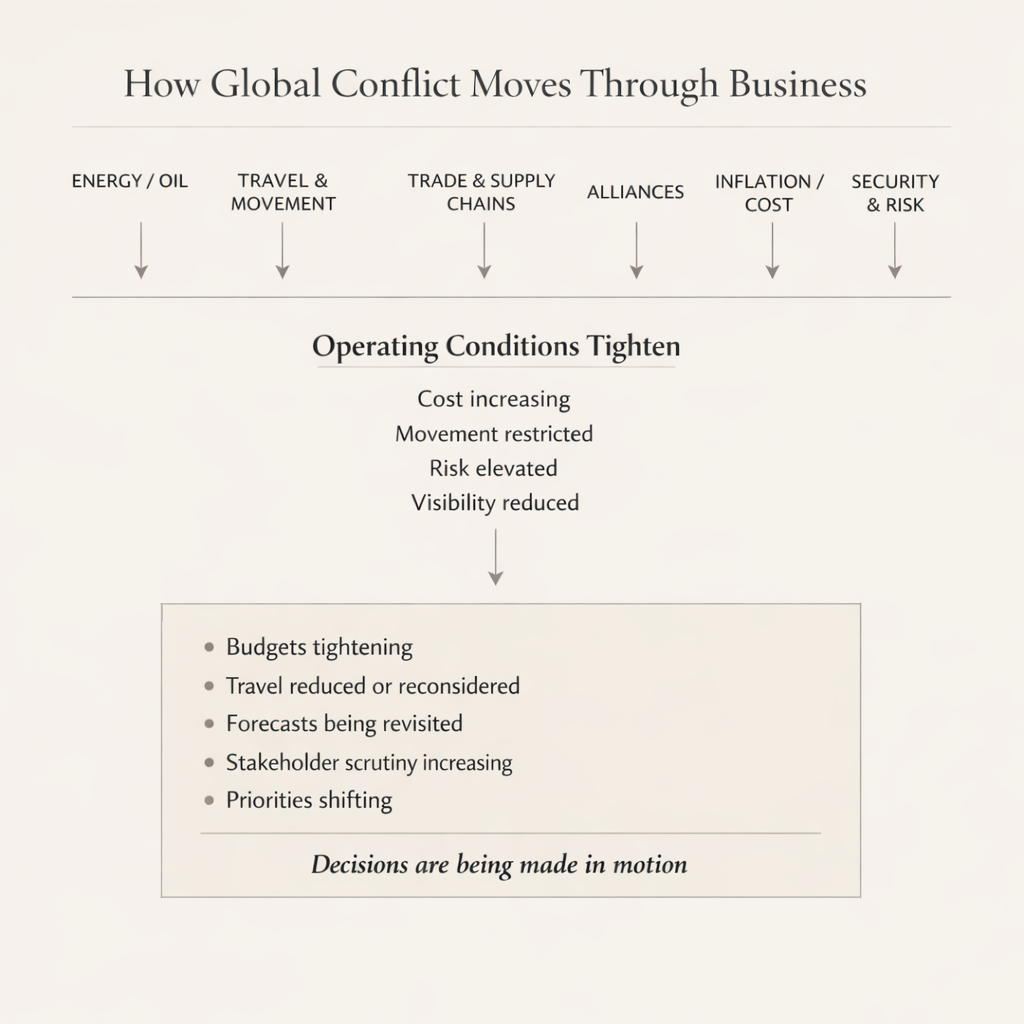
At the top of the graphic are the global pressure points:
- Energy and oil supply
- Travel and movement
- Trade and supply chains
- Alliances and geopolitical positioning
- Inflation and cost pressure
- Security and risk
These forces don't operate independently. They shift together and influence one another.
The arrows show how these pressures move downward through the system.
As they converge, operating conditions tighten.
Cost increases, movement becomes more restricted, risk elevates, and visibility reduces.
This pressure does not stay external. It flows directly into organisations.
Inside the organisation, this shows up through:
- Tightening budgets
- Adjustments to travel and spend
- Forecasts being revisited
- Increased stakeholder scrutiny
- Shifting priorities
At the centre of this is one constant:
Decisions are being made in motion.
Leaders are making decisions while conditions are still moving, often without full clarity and with the expectation those decisions may need to change.
3. Strategic Implications
- Cost pressure is moving faster than planning cycles
Energy, travel and supply chain disruption are flowing into cost bases quickly, often outpacing budget assumptions and forcing mid-cycle adjustments. - Forecasting is becoming conditional, not fixed
Plans are being built on assumptions that may not hold. This increases the need for shorter decision cycles and more frequent recalibration. - Risk is being reassessed in real time
Travel, operations and people-related decisions are being revisited as conditions shift, with greater attention on exposure and duty of care. - The first moves create the least disruption, not the best outcome
Reducing travel and discretionary spend provides immediate control, but does not resolve the underlying pressure, which continues to build elsewhere. - Stakeholder scrutiny is increasing
Boards and senior leadership are asking for clearer visibility on how organisations are responding, particularly where cost, risk and continuity intersect. - Organisations are balancing competing pressures simultaneously
Financial performance, employee wellbeing and operational continuity are all being managed at once, with no clean way to optimise all three. - Productivity expectations remain unchanged despite harder conditions
- There is little tolerance for slowdown, even as the environment becomes more complex and constrained.
- There is no clear point at which these conditions stabilise, increasing the need to operate effectively while they continue to shift
4. What Headlines Aren't Saying
The pressure isn’t just showing up in cost lines or headlines. It’s showing up in how decisions are being made.
Leaders are not working from clear plans right now. They're adjusting in motion, often without full visibility, and sometimes without confidence that the decision will hold.
In this environment, there are no clean choices. Only trade-offs.
Cost versus continuity.
Speed versus risk.
Employee impact versus financial pressure.
The first response is usually predictable. Organisations pull the visible levers. Travel is reduced. Spend is tightened. Hiring is paused or slowed.
That creates the appearance of control.
But the real complexity sits underneath that.
Forecasts are being reworked while conditions are still shifting.
Decisions are being made knowing they may need to be revisited.
Pressure is absorbed quietly before it shows up in formal updates.
This is where most of the work sits. Not in the visible actions, but in the constant recalibration behind them.
What this means for you as an EA
Operating conditions are shifting faster than most organisations can stabilise around them.
Decisions are being made with less certainty, and the consequences of getting them wrong are higher.
Your Opportunity
When conditions are moving, value comes from recognising what is changing early and helping your executive respond with clarity.
Ask yourself
Where am I waiting for clarity before acting, when the reality is that decisions are now being made without it?
EA Conversation Starters
For Strategic Briefings:
“I’m noticing a few decisions being revisited. Do we want to step back and sense-check what’s shifting underneath?”
For Planning Sessions:
“Given how quickly things are moving, do we want to build in a bit more flexibility here?”
For Stakeholder Updates:
“Would it help to acknowledge where conditions are still moving and how we’re adjusting?”
Back-Pocket Confidence Cues
- “It feels like we’re adjusting as we go. Do you want me to track where decisions are shifting?”
- “There’s a bit of movement across priorities. Should we pause and realign before the next step?”
- “Do you want me to keep a close eye on what might need revisiting over the next week?”
5. EA Influence Moves
This edition isn't about doing more.
It’s about seeing more clearly and responding at the right moments.
When conditions are shifting, influence comes from staying connected to what is actually changing and helping your executive move through that without losing momentum.
Leverage Points
Strategic (C-Suite)
Support your executive in navigating competing pressures, not just managing activity.
- Track where priorities are shifting across conversations, not just what is being agreed
- Notice where decisions are being revisited and what is driving that change
- Prepare your executive for conversations where there is no clear answer, only trade-offs
- Surface patterns in stakeholder pressure, especially where expectations are tightening
- Anticipate where board or senior leadership scrutiny may increase and align ahead of time
This is less about coordination and more about maintaining continuity while direction is still forming.
Practical (Non-C-Suite)
Support clarity and stability within your immediate environment as conditions shift.
- Sense-check travel, spend and commitments before they become issues
- Keep communication steady when plans change, not just accurate
- Help your team adjust to shifting priorities without creating confusion
- Notice where pressure is building and escalate early
- Reduce noise so your executive can stay focused on what matters
This is about helping the work hold together when conditions around it are moving.
Stretch Yourself
Operate as someone who connects what’s happening outside the organisation to what’s happening inside it.
That might look like:
- joining the dots between headlines and internal decisions
- recognising patterns before they are formally discussed
- offering a perspective, not just executing a request
You’re not expected to have all the answers.
But you are often the closest to the moving parts, and that gives you a clearer view than most.
6. Practical Deployment Tools
EAs don’t just need insight. They need tools they can use when conditions are moving and clarity is partial.
These tools are designed to help you stay oriented, prepared and ready to contribute when it matters.
A. Pre-Meeting Checklist
Before your next leadership meeting, run this five-minute scan:
-
What external factors may be influencing this discussion right now?
-
Where might cost be under pressure?
-
Are there any travel, supply or operational risks to consider?
-
Have priorities shifted since the last conversation?
-
Is stakeholder scrutiny likely to come up?
-
Are any decisions likely to be revisited?
-
Where might your executive need to sense-check assumptions in the room?
B. Email Scripts & Talking Points
- “Given current conditions, would you like me to review upcoming travel and spend before the next meeting?”
- “I’m noticing a few priorities shifting. Would it help to consolidate where things are landing?”
- “Happy to map where this may start to create pressure across the next few weeks.”
- “Would you like a short summary of where we may see impact flow through?”
- “Let me know if it would help to sense-check this ahead of the discussion.”
These prompts help surface insight, create alignment and support clearer decision-making.
These are not scripts to follow. They are prompts to help you think, sense-check and contribute with confidence.
C. Conditional Clarity Tool
Refer back to Edition 06.
D. Conditional Decision Log
Refer back to Edition 06.
E. Track Your Impact
Insight only matters if it translates into outcomes.
Use this tracker to capture where you’ve created value in this environment:
- Where you identified a shift in priorities early
- Where you helped clarify or reframe a decision
- Where you reduced pressure or prevented rework
- Where you supported alignment across stakeholders
- Where you helped your executive stay focused as conditions changed
This becomes critical when performance is being assessed in tighter conditions.
7. Executive Ready Notes
Theme: When Conflict Reshapes Business Conditions.
When you only have a few minutes to prepare, this is your shortcut.
A one-page, executive-level summary you can carry into the room so you’re ready to contribute without re-reading the full Brief.
DOWNLOAD YOUR EXECUTIVE READY NOTES
8. Using The Brief with Care
Use judgement.
Not every signal will apply equally to your organisation, and not every shift requires a response.
Take a step back, consider your environment, and apply what is relevant.
The value is not in reacting quickly.
It’s in noticing what matters and responding with intent.
9. Urgency
Conditions are already shifting, even if they’re not fully visible yet.
The earlier you tune into what is changing, the better positioned you are to support the decisions that follow.
10. Go Deeper: Curated Reading
If you want to understand geopolitics at a deeper level, here are three book recommendations:
- Iran: The Looming Crisis - Emanuele Ottolenghi
- The Second World - Parag Khanna
- Arabian Plights, the future of the Middle East - Peter Rodgers
11. Audio briefing
Prefer to listen instead of read?
Each month, you’ll also find a short audio briefing from me. Think of it as a five-minute download — the context behind this edition, the shifts worth paying attention to, and the lens to carry into your thinking this month.
This month’s audio briefing covers:
- Why this conflict is already impacting business conditions
- Where pressure is building inside organisations
- What leaders are paying attention to right now
- How to interpret what’s happening beyond the headlines
- How to use this edition to support your executive effectively