Theme: When Change Doesn't Land
From the Editor
This edition of The Brief exists because organisations are changing faster than they are absorbing that change.
Across AI rollouts, operating model redesigns, restructures, and new ways of working, the pattern is the same. Initiatives are announced with confidence. Decks are circulated. Language shifts overnight. And yet, in the day-to-day reality of work, very little truly changes. New tools sit alongside old workflows. New processes coexist with old habits. Change is visible on paper, but inconsistent in practice.
This isn’t resistance. It’s something more structural.
In a context where volatility is no longer temporary but baked into how organisations now operate, leaders are moving quickly to adapt. But speed has started to outpace adoption. Many change initiatives are failing to “land” not because they lack merit, but because organisations are underestimating how fragile early-stage change actually is.
This matters for EAs because you sit at the intersection of strategy and execution. You see where initiatives unravel long before dashboards reflect it. You experience the friction between what leaders believe has shifted and what the organisation is actually able to hold. And in many cases, you are informally asked to stabilise the very change you were not included in designing.
EAs are central to change. You operate as sense-makers, translators, and continuity holders inside shifting systems. Yet too often, you are brought in after decisions have been made, rather than early enough for your insight, pattern recognition, and influence to shape how change is introduced and absorbed.
This edition of The Brief is about naming what’s really happening when change doesn’t land, why this is becoming more common in AI-first and transformation-heavy environments, and how to read the signals that separate performative change from change that actually holds.
The goal is not to make you responsible for fixing broken rollouts. It is to equip you with clearer sightlines into what’s happening in your organisation, so you can navigate change with more clarity, steadiness, and confidence.
- Rachael
1. Market Pulse - Decoded for EA's
Investors are asking CEOs what AI is really worth.
The real story you need to hear:
The market is shifting from “Are you using AI?” to “Is AI actually creating defensible value yet?”
Decoded for EA's
Investor conversations with CEOs reveal a growing pressure to move beyond AI experimentation and demonstrate tangible returns. Boards and markets are no longer satisfied with AI as a strategic narrative. They are interrogating where value is actually being realised, how risk is being managed, and whether organisations are genuinely ready to scale AI into core operations.
At the same time, the uncertainty is profound. Even analysts admit that forecasting AI-driven value beyond the next few years is highly speculative. This tension is creating a familiar organisational pattern: leaders feel compelled to move quickly to signal momentum, while the underlying operating conditions for adoption, capability building, and behavioural change remain fragile.
This gap between external pressure and internal readiness is one of the key reasons many AI initiatives are being launched with confidence, but failing to land in practice.
Stretch yourself here
Notice where “AI progress” is being described in terms of intent and investment rather than in terms of changed workflows, decision quality, or reduced friction.
Back-pocket confidence cue
“AI readiness isn’t just about tools. It’s about whether the organisation is actually set up to change how work gets done.”
2. Decoded Visual Snapshot
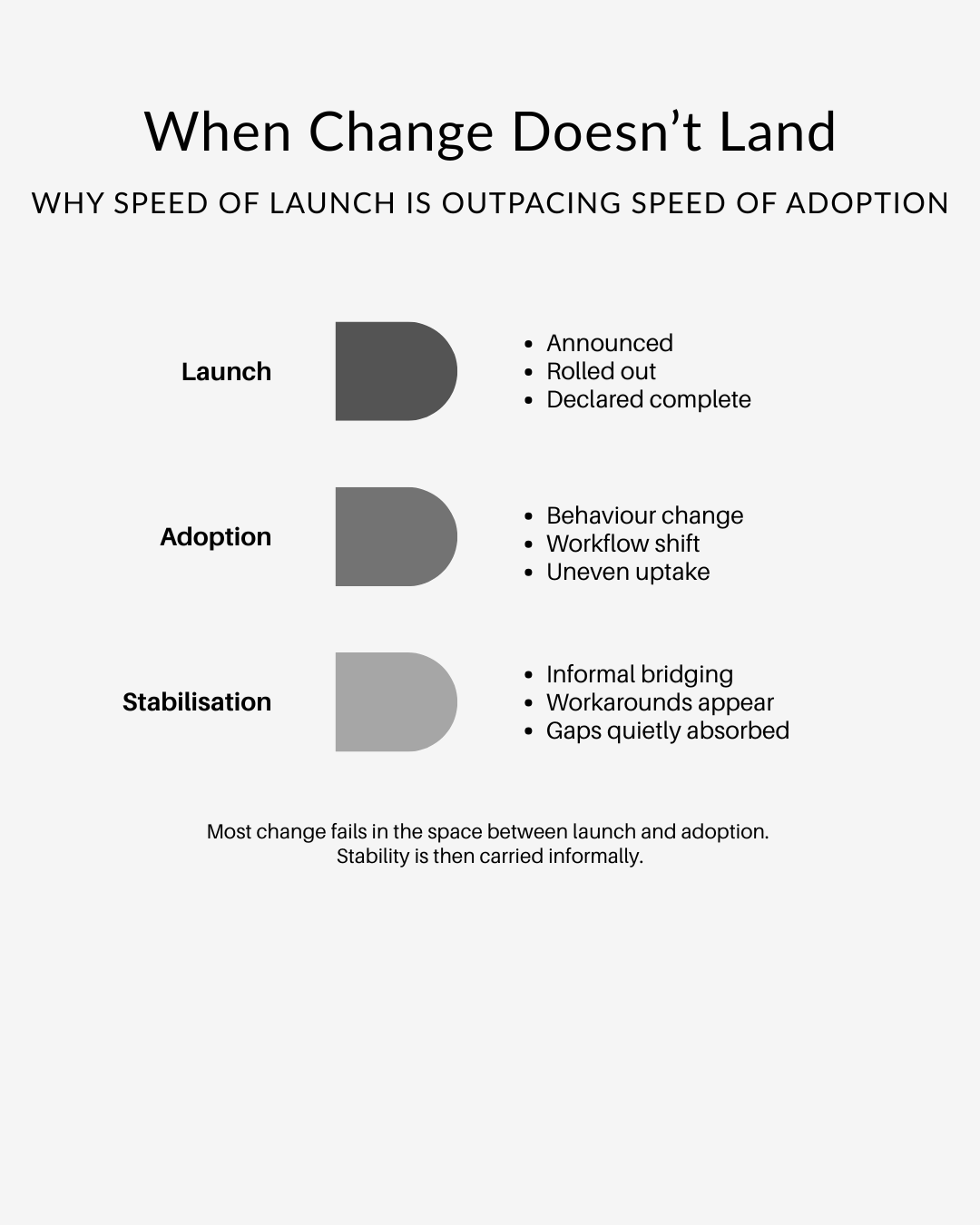
This snapshot shows where most change efforts actually falter: not at launch, but in the gap between rollout and real adoption.
3. Strategic Implications
When change fails to land, the cost isn’t just wasted investment. It reshapes how trust, credibility, and decision-making function inside the organisation. The implications below are not abstract. They are already playing out in how work is being done, how leaders are being perceived, and how operational risk is accumulating.
A. Announcements are replacing adoption as the Signal of Progress
In many organisations the visible marker of “progress” has become the announcement itself. AI-first strategies, operating model shifts, and new ways of working are being treated as milestones, even when day-to-day workflows remain largely unchanged.
B. Change Capacity Is Becoming a Scarce Organisational Resource
Structural volatility has increased the volume of change initiatives being run in parallel. Organisations are now competing with themselves for attention, energy, and execution capacity.
Strategic implication
When too many initiatives are in motion, even well-designed change efforts struggle to gain traction. This leads to quiet reversion to familiar ways of working under pressure. The organisation does not become more agile. It becomes more brittle.
C. Adoption Risk Is Becoming a Material Execution Risk
As AI and digital initiatives move closer to core workflows, the cost of partial adoption rises. Inconsistent uptake across teams introduces fragmentation, duplicated work, and decision lag.
Strategic implication
This creates uneven operating standards across the organisation. Leaders may believe a process has been standardised or a tool embedded, while in reality, parallel systems persist. This undermines data integrity, coordination, and decision quality at senior levels.
D. Credibility Is Being Eroded with Each False Start
Repeated false starts train the organisation to discount future change initiatives. Over time, people learn that waiting is often rational, because many initiatives do not survive contact with operational reality.
Strategic implication
This creates a slow erosion of leadership credibility. Not because leaders lack intent, but because the organisation’s lived experience teaches people that change declarations are provisional. This makes future transformation harder, slower, and more costly to land.
E. Informal Stabilising Roles Are Carrying More of the Load
When formal change programmes struggle to land, stabilising work shifts into informal channels. People close to the flow of work compensate for unclear processes, partial adoption, and misaligned systems.
Strategic implication:
Organisational stability increasingly depends on invisible coordination, sense-making, and continuity work. This labour is rarely captured in transformation plans, yet it becomes critical to preventing operational drag and decision breakdown as volatility and change velocity increase
4. What Headlines Aren't Saying
Most coverage of AI and transformation focuses on the systems being introduced and the speed of What Headlines Aren’t Saying
The headlines will tell you that AI rollouts and operating model changes are about speed, efficiency, and staying competitive. But here’s the story those headlines miss: when change is rushed, organisations don’t become more agile. They become more fragile.
Take the wave of “AI-first” announcements we’re seeing across large organisations. On paper, these initiatives signal momentum. In practice, many of them stall at adoption. New tools sit alongside old workflows. Teams revert to familiar processes under pressure. The change exists in strategy decks, but not consistently in the work.
The problem isn’t the technology. It’s that most change programmes underestimate the stabilising work required to carry the organisation through the transition. That work doesn’t disappear when a new system is launched. It shifts into informal channels. Someone has to bridge old and new ways of working so the machine keeps moving.
That stabilising layer is rarely designed into transformation plans. Yet without it, change doesn’t land. It just looks like it did.
What this means for you as an EA
This is where your vantage point becomes operationally valuable. You sit close enough to the work to see whether change is actually being absorbed or quietly worked around:
- You can see where new tools are layered on top of old processes rather than replacing them.
- You notice where teams revert to familiar ways of working when pressure spikes.
- You see where leaders assume a change has landed because it’s been announced, not because it’s embedded.
Because you see this early, you can surface adoption risk before it shows up as execution drag. That’s not about being resistant to change. It’s about protecting the organisation from overestimating how much change it is actually capable of holding at once.
Stretch Yourself Here
Your role isn’t just to support change. It’s to read whether change is landing in the work.
When a new system, process, or “AI-first” initiative is announced, ask yourself:
- Where is the old way of working still quietly doing the heavy lifting?
- Who is informally bridging the gap between what’s been launched and what’s actually workable?
- If this change stalls, what pressure gets displaced onto leaders or critical roles?
EA Conversation Starters
For Strategic Briefings:
“We’ve launched the new workflow, but adoption looks uneven across teams. Do you want a quick read on where it’s holding and where friction is still showing up?”
For Planning Sessions:
“If we’re running multiple changes in parallel, it might be worth pressure-testing how much adoption capacity we’re assuming the teams actually have.”
For Stakeholder Updates:
“The tool is live, but there are still two handoffs sitting outside the new process. That’s where rework is likely to continue unless we design that step in.”
Back-Pocket Confidence Cues
- “Launch doesn’t equal adoption. The risk sits in the gap between the two.”
- “Where change hasn’t landed, informal work is carrying the load.”
- “If we don’t design for stabilisation, the organisation will stabilise itself in less visible ways.”
5. EA Influence Moves
Here’s where you translate what you’re seeing on the ground into influence. When change doesn’t land cleanly, the value you bring is not in fixing broken rollouts quietly. It’s in helping leaders see where adoption risk and stabilisation work are sitting so change can actually hold.
Leverage Points
✔ Adoption Sensing
Track where new tools or processes are being used as intended versus worked around under pressure.
✔ Stabilisation Mapping
Identify where informal bridging is happening between old and new ways of working.
✔ Change Load Awareness
Surface how many initiatives are hitting the same teams at once and where change fatigue is building.
✔ Execution Friction
Name where partial adoption is creating rework, duplication, or decision drag.
Strategic (C-Suite)
Invite a short, grounded view of adoption reality into leadership forums. This might look like a simple snapshot: where the change has embedded, where parallel workflows still exist, and where informal stabilising work is compensating for gaps. Position this as execution risk intelligence, not feedback on the initiative itself. The aim is to give your exec a clearer read on what is actually landing across the system.
Practical (Non-C-Suite)
Map where new processes or tools have been layered on top of existing workflows rather than replacing them. Highlight two or three specific handoffs where people are carrying informal work to keep things moving. This gives you a concrete way to show where change is being absorbed and where it is quietly being bypassed.
Stretch Yourself
Don’t just notice where change is stalling. Name the stabilising work that is holding the organisation together in the meantime. Framing that work as execution intelligence, rather than operational noise, is what shifts your role from making change workable to shaping how change is designed.
6. Practical Deployment Tools
You don’t just need to read about why change doesn’t land. You need a way to map where adoption is holding, where informal stabilisation is filling gaps, and where execution risk is quietly building.
That’s why this month’s Brief comes with a dedicated takeaway tool: two grids you can use to pressure-test how change is actually landing and bring foresight into your conversations.
A. Pre-Meeting Checklist
Use this before exec or leadership meetings where a new initiative, AI rollout, or operating model change is being discussed.
-
Where has this change genuinely embedded in daily workflows?
-
Where are parallel processes still running?
-
Who is currently bridging gaps manually?
-
Which teams are carrying the heaviest change load right now?
-
What is being assumed about adoption that hasn’t yet been validated?
B. Email Scripts & Talking Points
These scripts give you practical language for naming where change isn’t landing, without sounding resistant or overstepping your role
C. Change Adoption & Execution Risk Map
You don’t just need to notice where change isn’t landing. You need a way to make it visible so it can be discussed without it becoming personal or political.
These grids give you a practical way to pressure-test whether change is actually embedding or quietly being worked around.
Use them to map where new tools and processes have landed, where old ways of working still persist, and where informal stabilisation is propping things up. They’re designed to help you surface execution risk clearly and neutrally, so you can bring better foresight into planning and briefing conversations.
D. Quick Metrics You Can Drop
These are simple, directional signals you can reference without commissioning heavy analysis:
-
Number of parallel workflows still running post-launch
-
Time spent on manual workarounds
-
Rework volume tied to partial adoption
-
Decision delays caused by inconsistent process use
-
Number of teams still operating outside the new model
You’re not trying to prove failure. You’re surfacing where change is still fragile.
E. Track Your Impact
If you’re surfacing adoption risk or stabilisation work, track:
-
Where your early signal prevented rework or escalation
-
Where sequencing was adjusted as a result
-
Where informal stabilisation was formalised into process
-
Where leaders gained a more accurate read of execution reality
This isn’t about credit. It’s about building a record of foresight and execution intelligence.
7. Executive Ready Notes
When you only have a few minutes to prepare, this is your shortcut. A one-page, executive-level summary you can carry into the room so you’re ready to contribute without having to re-read the full Brief.
DOWNLOAD YOUR EXECUTIVE READY NOTES
8. Using The Brief with Care
For maximum impact, avoid:
-
Naming adoption gaps without pairing them with a stabilisation or sequencing suggestion.
-
Describing “change fatigue” in general terms rather than pointing to a specific workflow, handoff, or bottleneck.
-
Forwarding AI or transformation commentary without translating what it means for execution in your context.
-
Raising concerns about stalled change without pre-briefing the leader who owns the initiative.
-
Informally absorbing stabilising work without making the dependency visible to decision-makers.
9. Urgency
This edition is time-sensitive.
Many organisations are entering a second and third wave of AI and operating model change while the first wave has not fully landed. Change capacity is being stretched, and informal stabilisation is doing more of the heavy lifting than leaders often realise.
If adoption risk is not surfaced early, organisations will continue to mistake launch for progress, eroding credibility and increasing operational fragility with each false start. The longer this pattern runs, the harder it becomes to embed future change.
This is the moment to pay attention to what is actually holding change together in your organisation, before those informal stabilising mechanisms are overextended or lost.
10. Go Deeper: Curated Reading & Listening
If you want to go deeper, here are three sharp reads that expand on this month’s theme. These have been selected to deepen your understanding without adding to the noise.
AFR: What investors are actually asking CEOs in private meetings
This piece captures the external pressure now sitting on leaders to justify AI investment in terms of realised value, not intent. It’s a useful lens on why so many organisations are moving fast on AI before the conditions for adoption are fully in place.
Harvard Business Review: The judgment gap in the age of AI
This article underpins the thinking in this edition of The Brief. It explains why AI initiatives often fail to deliver meaningful value when organisations overestimate tool capability and underestimate the human judgement and adoption work required to embed change.
Book Recommendation: Upstream: How to Solve Problems Before They Happen (Dan Heath)
A practical, accessible book on designing for prevention rather than reacting to failure. Particularly relevant for this edition’s theme, it offers a clear framework for spotting where breakdowns are likely to occur and addressing root causes before they show up as execution issues.
11. Audio briefing
Prefer to listen instead of read?
Each month, you’ll also get a short audio briefing from me. Think of it as your five-minute download: the context behind this edition, the shifts to notice, and the cues you can carry straight into your week.
This month’s audio briefing covers:
-
Why organisations are moving faster than their capacity to absorb change
-
What’s really sitting underneath stalled AI and transformation initiatives
-
How informal stabilising work is propping up change that hasn’t landed
-
The execution risks leaders often underestimate in early-stage change
-
Where your vantage point gives you early sight of adoption breakdowns