Theme: From stability to conditionality
Work is no longer organised around stable systems and assumed trust. It now operates on shifting conditions, selective cooperation, and situational judgement.
What’s Inside
✔ Market Pulse
Global signals decoded:
Davos confirmed what many organisations are already feeling but struggling to name. Trade, cooperation, and security are no longer governed by fixed rules or long-term alignment. Trickling down to inside organisations, leaders are operating inside adaptive systems where speed, optionality, and context matter more than permanence or precedent.
✔ Overlooked Risk
Most organisations are still behaving as though stability is the baseline.
The risk is not volatility itself. The risk is misreading conditional systems as temporary disruption, and continuing to rely on assumptions, roles, and rhythms that no longer hold.
✔ Framework Snapshot
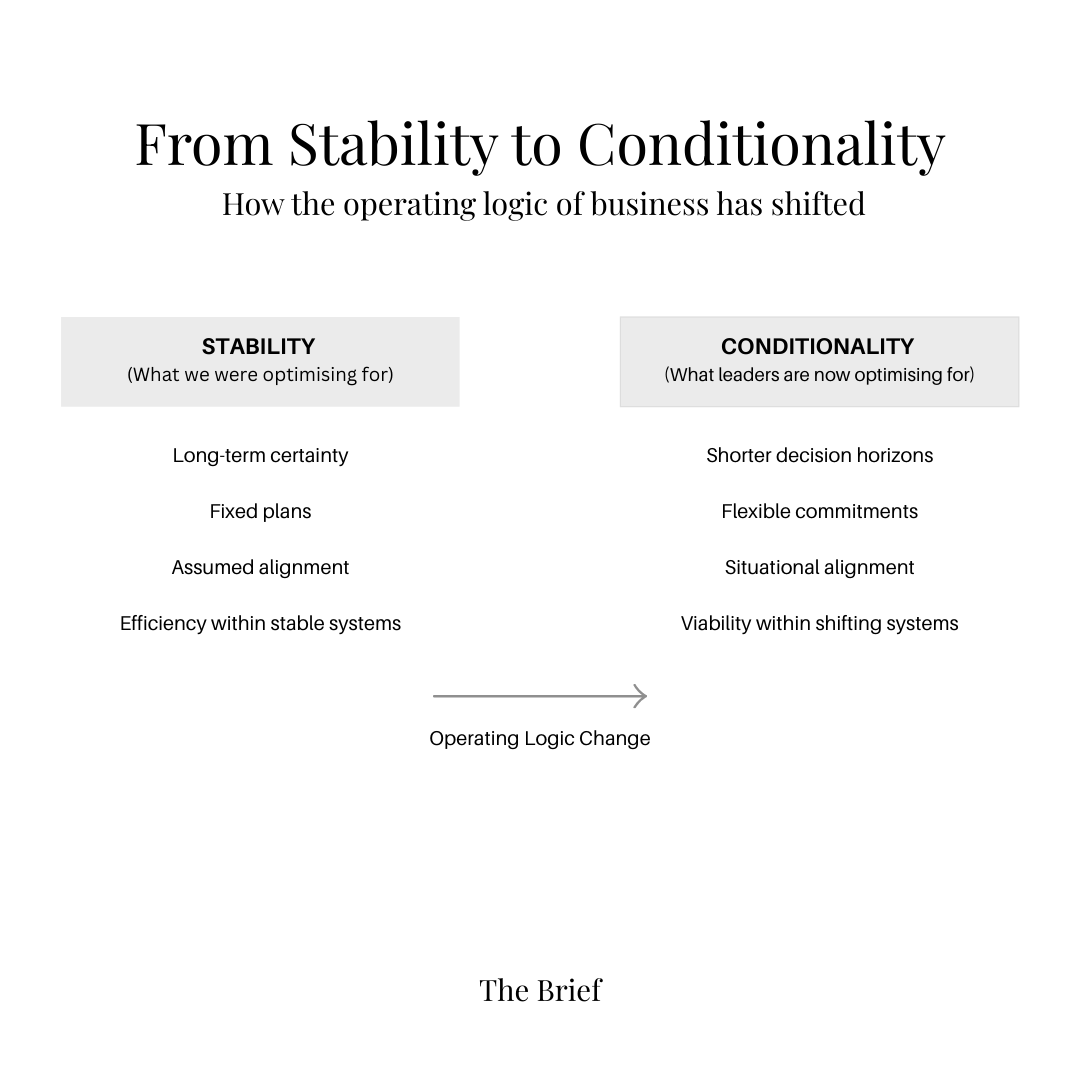
This graphic shows a shift in operating logic, not a change in priorities.
Historically, organisations were designed to perform well when conditions broadly held. Plans assumed stability, alignment was taken as a given, and efficiency was optimised within relatively predictable systems.
That assumption no longer applies.
Across policy, business, and global cooperation, leaders are now operating in conditions that change faster than plans can lock in. The response isn’t disorder — it’s conditionality. Decisions are made to work for now, with flexibility built in for what may shift next.
✔ Deployment Tools
-
How conditionality is showing up in decision-making, prioritisation, and timelines
-
Where speed is being valued over certainty, and why
-
What this means for collaboration, ownership, and escalation
-
A short reframing prompt to help reset conversations when conditions shift mid-decision
-
A prioritisation lens to distinguish what still matters from what can safely move or drop
✔ Executive Quick View
A one-page summary for you to review quickly when preparing for meeting with your executive. setting out:
-
The core signals emerging post-Davos
-
What conditionality means for how decisions are being made
-
Three sharp questions leaders should be asking right now to avoid blind spots
Why This Matters
Because many of the tensions people are experiencing at work are not performance issues. They’re system issues.
Conditional environments change how trust is granted, how influence is earned, and how value is judged.
Your Opportunity
Ask yourself:
Where am I still working from assumptions that no longer apply?
What signals am I noticing that others may be missing?
How can I reduce friction when conditions change rather than resisting it?
Next Month
Every edition explores a new theme. Fresh signals, fresh tools, and a new lens for showing up strategically in a shifting world of work.
From the Editor
In the thick of the geopolitical tensions shaping early 2026, world leaders, policymakers, and business executives converged in Davos for the Annual Meeting of the World Economic Forum. The conversations spanned trade, security, energy, technology, and capital, not as separate agendas, but as interlinked pressures reshaping how the global system is now operating.
Beneath the formal statements and public positioning sat a more pragmatic discussion. One less focused on restoring balance, and more on functioning effectively without it. Markets responded accordingly. Not with shock, but with adjustment.
What emerged was not a vision of a world returning to familiar ground, but one recalibrating around new rules. Cooperation discussed in narrower terms. Dependencies examined with greater scrutiny. Speed prioritised over permanence. Decisions framed with an acceptance that conditions will continue to shift, and that waiting for stability is no longer a viable posture.
This edition was shaped by the conversations coming out of Davos, but its implications reach far beyond geopolitics. The shift from stability to conditionality is already reshaping how organisations operate, how leaders decide, and how trust is formed. Seeing it clearly is the first advantage.
This month’s Brief is designed to help you enter those conversations differently. Not by keeping pace with headlines, but by recognising what they leave unsaid and awaits on the horizon. Your edge lies in translating those signals into foresight in the room.
- Rachael
1. Market Pulse – Decoded for EAs
The conversations coming out of Davos made one thing clear. Organisations are no longer working from the assumption that conditions will stabilise. They’re operating as though change is permanent, and decisions will increasingly need to be made before clarity arrives.
Here’s the real story you need to hear:
Stability is no longer the organising principle. Conditionality is.
■ This is the ripple effect your executive is already navigating:
-
Decisions are being made with shorter runways and fewer guarantees
-
Cooperation is tighter, more selective, and more outcome-driven
-
Trust, access, and influence are increasingly situational rather than assumed
-
Speed is prioritised, even when execution will need to catch up later
This isn’t disorder. It’s a different operating logic.
Here’s the opportunity for you
EAs sit at the intersection of intent and execution.
You see:
-
Where assumptions no longer hold
-
Which workflows are fragile under shifting conditions
-
Where leadership load is increasing quietly
-
Which dependencies would strain first if priorities shifted again
In a conditional system, this perspective becomes strategic value.
Stretch Yourself Here
This is not the moment to wait for recognition or clarity.
When organisations operate inside permanent uncertainty, the most valuable partners are those who can reduce friction, surface risk early, and stabilise decisions without slowing momentum.
Use this intelligence not just to read the room — but to shape it.
Back-Pocket Confidence Cues
-
“Where are we still operating as though conditions will hold, rather than change?”
-
“If this decision had to flex in six months, which parts of our operation would struggle to adjust?”
-
“Which assumptions are we making here that only work if stability returns?”
-
“What looks efficient right now, but becomes fragile if priorities shift again?”
-
“Where are trust and access still implicit, when they may need to be earned more deliberately?”
2. Decoded Visual Snapshot
What the signal is showing
The graphic reflects a world that has crossed a threshold.
For decades, business operated on the assumption that systems would broadly hold. Alliances were stable. Rules were predictable. Disruption was episodic.
That assumption no longer applies.
Policy makers, politicians, and senior business leaders are now openly acknowledging what was previously implied: we are operating in conditions that are structurally different, and unlikely to revert.
This is not turbulence within the system.
It is a change in the system itself.
Decoded Takeaway
When conditions are no longer stable, continuity cannot be assumed — and strategy, trust, and cooperation all become conditional.
3. Strategic Implications
When this shift is viewed clearly, several implications follow.
Not as tactics, but as a new operating logic.
-
Alliances are provisional
Cooperation still exists, but it is narrower, more deliberate, and more reversible. Alignment is situational, not guaranteed. -
Certainty is no longer the prerequisite for action
Decisions are increasingly made with the expectation they may need to be adjusted. Waiting for clarity is no longer a neutral choice. -
Risk is being reframed
Dependence, rigidity, and over-optimisation are now seen as liabilities. Optionality and flexibility carry greater strategic weight.
These shifts are subtle, but they change how leaders evaluate judgement, partnership, and value.
4. What Headlines Aren’t Saying
Most commentary focuses on events. Tariffs. Elections. Conflicts. Technology.
What is less often named is the underlying acknowledgement emerging at the top:
the world is no longer organised around shared assumptions.
This is why alliances are questioned.
Why commitments are hedged.
Why speed is prioritised over elegance.
Why strategy is framed with more caveats than conclusions.
It’s not confusion.
It’s adaptation to a world where conditions no longer hold long enough to rely on precedent.
What This Means for You as an EA
When operating logic changes, so does what senior leaders need around them.
They are navigating:
-
Fewer assumptions
-
Shorter decision horizons
-
More conditional cooperation
-
Greater exposure if judgement is misread
Your proximity gives you a rare advantage. You’re close enough to see where old assumptions are still being applied to new conditions.
That awareness is not administrative.
It is strategic.
Stretch Yourself Here
This moment calls for a shift in how you interpret what’s happening around you.
Instead of asking, “What’s the right process?”
Ask, “What assumptions is this decision resting on?”
Instead of asking, “What’s the plan?”
Ask, “What would cause this plan to unravel?”
That reframing is how people stay useful when the ground keeps moving.
EA Conversation Starters
For Strategic Briefings
“It feels like some of the assumptions that used to hold are no longer doing so. Would it be useful to pressure-test which ones we’re relying on here?”
For Planning Sessions
“If we assume conditions continue to shift, where does this approach stay strong — and where does it become exposed?”
For Stakeholder Updates
“This positions us to adjust if alliances, priorities, or conditions change again.”
Back-Pocket Confidence Cues
-
“Which parts of this rely on stability returning?”
-
“Where are we assuming alignment that may now be conditional?”
-
“What changes if this decision needs to flex sooner than expected?”
5. EA Influence Moves
Here’s where this edition becomes practical.
When conditions are constantly shifting, influence doesn’t come from having the answers. It comes from helping leaders think clearly when assumptions no longer hold.
Your influence grows when you can:
-
Help leaders slow the thinking, not the pace
-
Spot where old assumptions are being applied to new conditions
-
Connect the dots between the macro environment and the landscape your organisation operates within, and the domino impact of change
Leverage Points
✔ Strategic (C-suite)
At the most senior level, leaders are making decisions with less certainty and shorter timeframes.
Your influence here shows up when you:
-
Flag where a decision may need to flex later
-
Help clarify what is fixed versus what is still open
-
Notice when alignment is assumed, rather than tested
This doesn’t require long conversations. Often it’s a well-timed comment or follow-up question that helps a decision land more cleanly.
✔ Practical (Non-C-suite)
For teams and stakeholders outside the C-suite, conditionality often feels like mixed messages or constant change.
Your influence here shows up when you:
-
Help people understand what hasn’t changed, even when priorities move
-
Translate direction in a way that reduces confusion
-
Reinforce intent when plans need to adjust
This helps maintain momentum without creating unnecessary churn.
Stretch Yourself
Influence in this environment is subtle.
Instead of stepping in to fix or smooth things over, practise:
-
Pausing before offering solutions
-
Naming uncertainty without amplifying it
-
Helping others see where flexibility is built in
That’s often more valuable than being immediately helpful.
6. Practical Deployment Tools
EAs don’t just need insight. They need tools they can use when conditions are moving and clarity is partial.
These tools are designed to help you stay effective, credible, and steady when decisions are being made without the comfort of stable ground.
A. Pre-Meeting Checklist
Before your next leadership meeting, run this five-minute scan:
-
What assumptions are sitting underneath this agenda?
-
Which items assume conditions will stay the same?
-
Where might alignment be provisional rather than settled?
-
What decisions could need to flex after today?
-
What context might change how this lands?
This helps you listen for what’s holding and what’s conditional in the room.
B. Email Scripts & Talking Points
Five lines you can use as-is
-
“This feels directionally right. Where do we want to leave room to adjust if conditions change?”
-
“What’s fixed here, and what’s still open?”
-
“If this needed to flex later, what would we want to protect?”
-
“Are we assuming alignment, or do we want to check it?”
-
“This keeps us moving without locking us into something too rigid.”
These sound thoughtful, not hesitant.
C. Decision Reset Prompt
Use this when a conversation starts to drift or harden too early:
“If we were making this decision again in three months, what might we do differently?”
It gently re-opens thinking without undermining momentum.
D. Conditional Clarity Tool
When relaying direction to others, separate the message into three parts:
-
What’s clear now
-
What’s likely to change
-
What we’ll review as conditions evolve
This reduces confusion without over-promising certainty.
DOWNLOAD THE CONDITIONAL CLARITY TOOL
E. Conditional Decision Log
When conditions are shifting, value comes from noticing patterns over time — not reacting to each decision in isolation.
This simple log is designed to help you track how decisions are being made when certainty is limited. It’s not about outcomes or accountability. It’s about building judgement.
Use it quietly to sharpen your own thinking, or intentionally to evidence the strategic lens you’re bringing to your role.
What to capture:
-
Decision or topic
-
Assumptions at the time
-
Conditions the decision depended on
-
What was fixed versus flexible
-
What shifted later (if anything)
Over time, this creates clarity about where your organisation (or on a more localised scale, your team) is adapting well — and where old assumptions may still be in play.
DOWNLOAD THE CONDITIONAL DECISION LOG
F. Track Your Impact
Insight only matters if it translates into outcomes.
This tracker helps you capture where you’ve created impact from this edition — so you can make your contribution visible to your executive and team.
Use it to note:
-
Where you helped surface assumptions
-
Where you supported a decision that needed flexibility
-
Where your input helped maintain coherence as things shifted
Over time, this builds a clear picture of your strategic contribution.
Executive-Ready Notes
From Stability to Conditionality
When you only have a few minutes to prepare, this is your shortcut.
A one-page, executive-level summary you can carry into the room so you’re ready to contribute without re-reading the full Brief.
DOWNLOAD THE EXECUTIVE READY NOTES
7. Using The Brief with Care
For maximum impact, avoid:
-
Raising risks without at least one resilience move.
-
Anecdotes without a simple pattern or metric.
-
Forwarding research without your translation.
-
Surprising stakeholders who should have been pre‑briefed.
-
Commissioning work (like finance, risk or HR/P&C reporting) without approval.
8. Urgency
February 2026 sits at a pressure point.
Organisations are finalising priorities for the year while operating under conditions that are already shifting again. Political alignment is less predictable. Trade and security settings are being recalibrated in real time. Business leaders are moving from scenario planning to live decision-making.
What was previously discussed as “uncertainty” is now being treated as a permanent feature.
This matters now because:
-
First-quarter decisions are setting direction with fewer assumptions than before
-
Leaders are locking in strategies that may need to flex sooner than planned
-
Old models of stability are quietly being retired, without formal announcement
Reading this now helps you recognise why decisions feel different, and adjust how you contribute while there is still room to influence direction.
Wait, and this becomes hindsight.
9. Go Deeper: Curated Reading & Listening
If you want to go deeper, here are three reads that expand on this month’s theme from the Davos annual meeting — carefully chosen so you don’t drown in noise.
https://www.ft.com/content/deb0b172-0e47-410c-b458-d4319877bcd6
https://www.weforum.org/meetings/world-economic-forum-annual-meeting-2026/
https://ec.europa.eu/commission/presscorner/detail/en/speech_26_150
10. Audio briefing
Prefer to listen instead of read?
Each month, you’ll also find a short audio briefing from me. Think of it as a five-minute download — the context behind this edition, the shifts worth paying attention to, and the lens to carry into your thinking this month.
This month’s audio briefing covers:
-
Why Davos matters in 2026 — and what this year’s conversations signal
-
How leaders are adjusting to conditions that no longer hold by default
-
What the shift from stability to conditionality means for everyday decision-making
-
How this edition helps you interpret what you’re seeing inside your organisation
-
The mindset to apply as you move through meetings and decisions this month