What’s Inside
The 2026 Leadership Tensions Map
A clear view of the five tensions influencing executive behaviour and how they show up in real time across organisations.
Q1 Impact Map
A guided tool to map your executive’s reality, the signals in your organisation, where your work has the greatest leverage and the specific moves you will make this quarter.
Deployment Toolkit
Advanced, practical tools you can use immediately:
-
Priority Reset Dialogue to recalibrate direction and operating rhythm with your executive
-
Responsibility Realignment Audit to identify and rebalance responsibility creep at a system level
-
Meeting Cadence Reframe to redesign time, cognitive load and decision quality across the week
-
One Workflow, One Win micro integration plan to de risk tech and AI adoption through controlled experiments
-
The Value Architect, a quarterly calibration to define your operating edge and the conditions you intend to shape
Why This Matters
-
Leaders are making decisions inside pressure stacks that are rarely articulated and almost never captured in internal comms.
-
Those pressure stacks drive reprioritisation, drift, fractured focus and strain on capacity that lands directly in your day to day.
-
When you can name the forces shaping your executive’s world, you reduce guesswork, protect your energy and increase the quality of your contribution.
This edition is designed to help you see what is driving the year before it shows up as chaos in your inbox and calendar.
Your Opportunity
You might ask yourself:
-
Which of these tensions is my executive most affected by right now
-
How is that tension shaping the way they use my time and attention
-
Where am I absorbing the impact rather than influencing the conditions
Which single tool in this edition, if I used it well, would create the greatest sense of coherence in Q1.
Next Edition
The February edition will centre on a real world case study selected from the strongest emerging business signal at the time. Well break down why it matters, what it reveals about the way organisations are operating and how you can use the insight to work with sharper judgement and influence. Tools included will help you translate the learning into your day to day.
From the Editor
The start of a new year often brings a surge of activity. New goals, refreshed priorities, shifting expectations, and renewed pressure to move faster than the year before. But the leaders I have been working with are not focused on any of that at the surface level.
They’re carrying pressures that are harder to see, faster moving than before, and deeply influenced by forces that sit well outside their calendars.
Here’s the part that matters for you: those pressures shape how they think, decide, delegate, communicate and rely on you.
If you only track what is visible, you will miss the signals that determine the year ahead.
This edition goes beneath the surface. It names the five tensions I’m seeing across organisations, in boardrooms, in strategy conversations, in the aftermath of restructures, and in the real time behaviour of leaders who are being pulled in opposing directions.
These tensions are not theoretical or abstract.
They surface in constant reprioritisation.
They intensify pace to the point of strain.
They push work sideways into your role.
They add weight to tech adoption.
They make value harder to articulate with confidence.
You don’t need to solve these tensions but you need to understand them.
Once you can name what is shaping your executive’s reality, you can support them with clarity rather than guesswork. You can influence the conditions they operate in. And you can anchor yourself in the work that genuinely moves the needle rather than the noise.
What follows is your early year intelligence briefing: what is happening under the surface, how it shows up, and what it means for the way you work.
Because 2026 will not reward speed alone.
It will reward accuracy, insight and clarity, and that begins with understanding the landscape your executive is navigating long before they have time to explain it.— Rachael
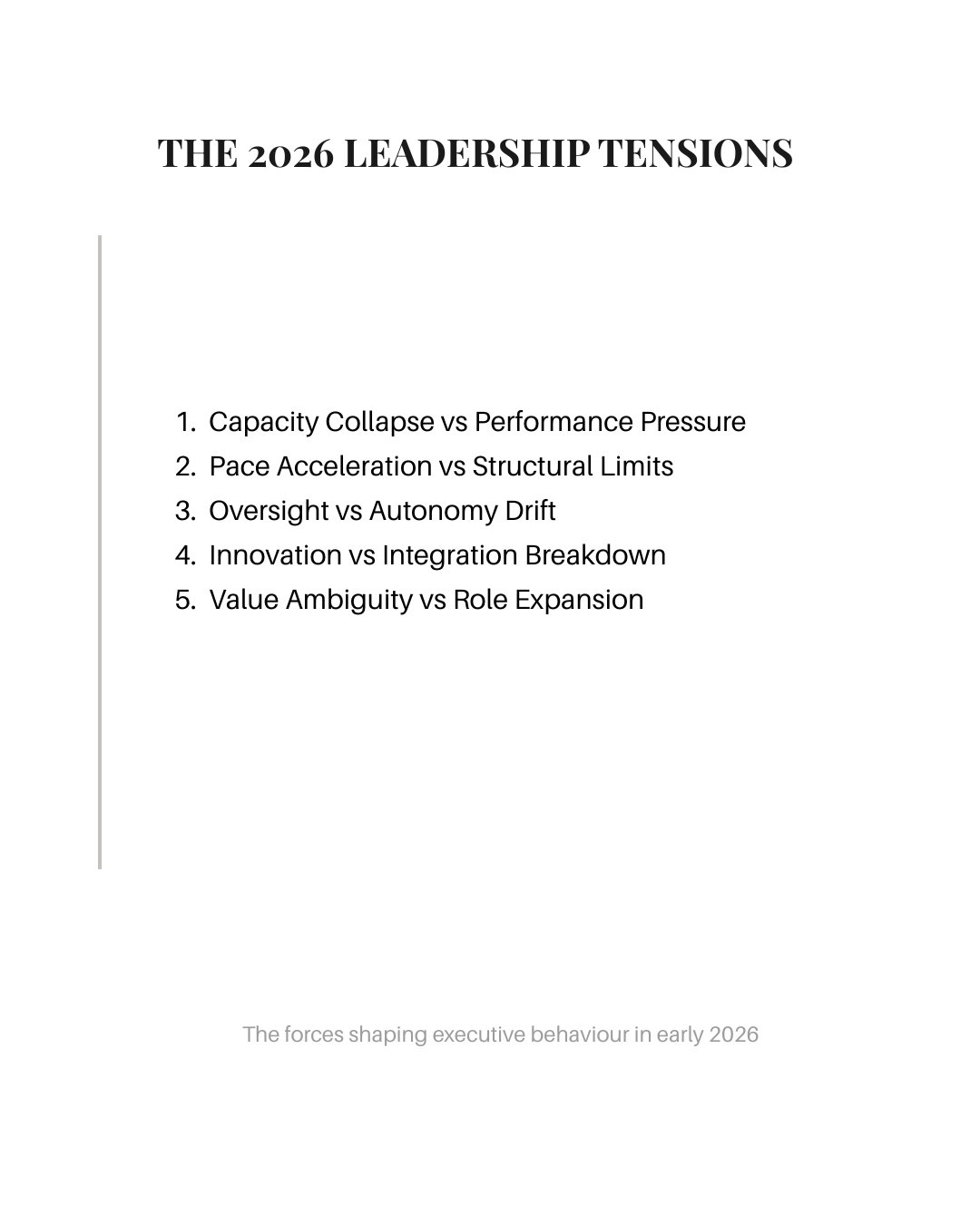
1. THE FIVE TENSIONS
TENSION 1: Capacity Collapse vs Performance Pressure
Many organisations reduced headcount in 2024 and 2025 under the banner of “efficiency.” What didn’t change were expectations. Targets held. Deliverables remained. The work didn’t shrink — the teams did.
EAs are feeling the impact first.
You’re seeing it in the constant reprioritisation, the unfinished work, the exhaustion, and the increasing need to triage rather than progress.
What’s driving this:
Leaders are being asked to deliver more with less while managing reputational and financial pressure. When capacity collapses but ambition stays the same, leaders default to speed, not strategy. This is why decisions feel rushed. It’s why clarity is missing. It’s why everything feels urgent.
Micro-case signal:
In several organisations recently, restructures were announced as a step toward agility. Within weeks, those same teams were working longer hours, carrying heavier expectations, and leaning on EAs to hold the structure together while the dust settled.
EA Line of Sight
-
Reprioritisation is a structural signal, not a competency issue
-
Your executive needs clarity more than they need speed
-
Protecting their focus time is no longer administrative — it’s strategic
-
Your vantage point allows you to see capacity gaps before they escalate
-
You are the early-warning system for misalignment
Strategic Move for January
Map your executive’s priorities against the actual time available. Present a realistic operating rhythm that reflects capacity — not wishful ambition.
TENSION 2: Pace Acceleration vs Structural Limits
The pace of work has increased. The structure of work has not.
Teams are being asked to move faster without revisiting the processes, communication rhythms, or capability they need to sustain that pace.
This is why many EAs tell me they feel like they’re “running on a moving floor.” The ground underneath them is shifting faster than the systems that support it.
What’s driving this:
Leaders know the environment demands speed, but organisations haven’t rebuilt their foundations. They’re accelerating without redesigning the engine.
Micro-case signal:
I’ve seen organisations lean down only to maintain the same meeting cadence, reporting structures, approval processes, and cross-functional dependencies. The result: teams grinding through change rather than moving through it.
EA Line of Sight
-
You’re the stability point in an unstable operating rhythm
-
Leaders are overwhelmed because structure hasn’t caught up with strategy
-
Information overload is a symptom of poor design, not poor discipline
-
Faster decisions paired with unchanged processes create friction
-
You can influence the pace by shaping the flow
Strategic Move for January
Redesign your executive’s meeting cadence for quality over quantity. Fewer, deeper touchpoints. Less fragmentation. More coherence across their week.
TENSION 3: Oversight vs Autonomy Drift
Responsibility creep is everywhere right now.
Not because leaders are deliberately pushing work onto EAs, but because pressure narrows a leader’s tolerance for ambiguity.
When confidence dips, oversight increases.
When teams are stretched, work drifts to the person who can be trusted.
EAs are often that person.
What’s driving this:
Leaders are holding more risk. When something matters, they either pull it closer or hand it to the person who has the judgment to manage it. Unfortunately, this creates blurred boundaries and unsustainable expectations.
Micro-case signal:
Multiple EAs have described taking on work that previously belonged to entire functions — comms, operations, stakeholder management — simply because the organisation is over-stretched and they’re the safest pair of hands.
EA Line of Sight
-
Oversight is often fear-based, not competency-based
-
Responsibility creep indicates systemic gaps, not personal opportunity
-
Your job isn’t to absorb work — it’s to interpret why it’s drifting
-
Leaders need clarity more than compliance
-
You can reset expectations without undermining trust
Strategic Move for January
List everything that has drifted into your role. Categorise it by whether it stems from capacity, skill gaps, or ambiguity. Then propose a redistribution map with rationale.
TENSION 4: Innovation vs Integration Breakdown
New tech is everywhere. Integration isn’t.
This gap is widening, and EAs are caught in it.
Many EAs are being asked to “lead the change” without clarity, training, or authority. Others are handed tools with the expectation they’ll just know how to make them work. The pressure is heavy, and the roadmap is often missing entirely.
What’s driving this:
Leaders underestimate how disorienting technology shifts feel for teams. Organisations buy tools faster than they build capability. The emotional resistance to change is stronger than most leaders acknowledge.
Micro-case signal:
I’ve heard from several EAs who received licenses to new AI tools before leadership had even agreed on what problem the tools were meant to solve. The confusion wasn’t about the technology — it was about purpose, ownership, and sequence.
EA Line of Sight
-
Adoption fails at the point of integration, not installation
-
You are often the translator between “how the tool works” and “how the work works”
-
Emotional resistance is part of the change curve — not a barrier
-
Influence lies in simplicity and sequencing
-
Leaders rely on you more than they realise
Strategic Move for January
Choose one workflow. Pilot one change. Demonstrate one small improvement. Show, don’t tell.
TENSION 5: Value Ambiguity vs Role Expansion
There is more noise in the EA space than ever.
Automation narratives. Cost-saving discussions. Efficiency targets. Changing role expectations. The rise of “strategic” as a buzzword.
It’s no wonder so many EAs are asking, “Where do I create the most value now?”
What’s driving this:
As roles evolve, leaders aren’t always articulating what “high value” looks like. And with labour-intensive work increasingly automated, EAs feel pressure to redefine their contribution — fast.
Micro-case signal:
EAs across industries tell me they know they’re essential but struggle to articulate it — especially when their work is relational, anticipatory, and often invisible.
EA Line of Sight
-
Your value lies in judgment, clarity, connection, and friction removal
-
Impact is measured by outcomes, not volume
-
Narrating your value is not self-promotion — it's leadership
-
The lack of clarity you feel is the same lack of clarity leaders feel
-
You shape how your role evolves far more than you realise
Strategic Move for January
Create a one-page Impact Map that links your work with organisational priorities. Use outcomes, not tasks.
2. THE Q1 IMPACT MAP
Your strategic lens for turning insight into influence
This map helps you translate what your executive is navigating beneath the surface into the work that truly moves the needle. Use it to create clarity, focus, and alignment and to anchor your operating rhythm for January–March.
Your role isn’t to do more, it’s to interpret more. Clarity is your greatest strategic asset in 2026.
3. DEPLOYMENT TOOLS
Practical assets to help you translate insight into influence immediately
Each tool is designed to stabilise pace, sharpen clarity, and help you support your executive at a strategic level. These are simple to use, high-impact, and intentionally crafted to meet the realities of early 2026.
A.Priority Reset Conversation Scripts
These questions help initiate a calm, strategic conversation that resets the pace and direction for your executive. It gives you language that brings coherence to the start of the year, clarifies what truly matters, and creates a realistic operating rhythm that supports focus rather than overwhelm.
B. Responsibility Drift Audit
This tool helps you identify responsibility creep early and redirect it with clarity and confidence. It reveals whether work is landing with you because of capacity, clarity, or capability gaps — and supports you in resetting boundaries without friction or defensiveness. It’s a practical way to protect your time and refocus your contribution.
C. Meeting Cadence Redesign Template
Calendar management at this level is not about efficiency, it's about shaping executive cognition. This tool helps you redesign the week as an operating system: where decisions are made, where thinking happens, and where flow is either protected or destroyed. Use it to create the conditions your leader needs to operate at their highest level and to help you redesign their meeting rhythm for the quarter ahead.
D. One Workflow, One Win: The Micro Integration Plan
High-performing EAs don’t “implement tech”. They de-risk adoption. This micro-integration method uses a controlled environment to demonstrate value, build trust, and increase readiness. It’s a low-noise, high-signal way to move a team toward new tools without the emotional resistance that derails most transformations.
E. Value Narrative Builder
Your contribution sits at the intersection of judgement, pattern recognition, and the ability to create conditions where high-value work can happen. This tool helps you articulate that contribution with the precision and altitude of someone who understands the business ecosystem, not just their function within it. Use it to refine how you show up, what you pay attention to, and the type of impact you intend to shape across the first quarter. It’s a thinking exercise, not a performance summary, and it positions you as someone shaping the environment rather than reacting to it.
4. Getting the Most From This Edition
A short guide to applying the insights with precision and relevance
This edition is designed to sharpen your lens, not expand your task list.
You don’t need to do more with what is inside - it’s here to help you think with it.
Here’s how to extract the highest value from this issue.
1. Read for patterns, not tasks
The five tensions are not tips. They reveal the forces shaping executive behaviour, organisational conditions and the pace of work. Notice where these tensions appear in your environment. The work looks different once you can name the forces beneath it.
2. Translate through the realities of your organisation
No two workplaces carry pressure in the same way.
Use these insights as interpretive frameworks so you can understand pace, drift, expectation and overload. Adapt them to your context. You know your terrain best.
3. Use the tools as calibration, not correction
Each tool is designed to refine your operating edge.
They support the way you interpret signals, where you apply leverage and how you influence rhythm, flow and clarity. They are not fixes. They are instruments that help you create the conditions where meaningful work can happen.
4. Start with the move that creates the most coherence
You don’t need to implement everything.
Choose one tool or practice that will materially improve the way you and your executive move through Q1. One well considered shift can create disproportionate stability.
5. Treat the Impact Map as a living document
Your Impact Map is not a once off reflection.
Use it as a quarterly design exercise that aligns your time, judgement and influence with what the business genuinely needs from you right now.
Revisit it as circumstances shift. Sharpen it. Replace assumptions with evidence.
6. Measure impact by movement, not volume
Impact is found in fewer resets, better decisions, reduced friction and a steadier pace.
These are the effects this edition is designed to help you create.
7. Hold this as leadership intelligence, not EA content
You’re not consuming tips. You’re absorbing the type of thinking senior leaders use to navigate complexity.
The value here comes from better judgement and deeper thinking, not more activity.
It is distilled organisational insight drawn from patterns emerging across sectors, from the behaviour of leaders under pressure and from the early signals shaping 2026.
It helps you see what your executive does not have time to say.
It equips you to interpret the landscape rather than react to it.
It strengthens the way you stand in your role with clarity, confidence and influence grounded in reality.
5. Using The Brief with care
The Brief provides high-level insights intended to be interpreted through your own organisational context. These ideas are not instructions; they are thinking tools. Apply what fits, adapt where needed, and always anchor your decisions in the realities of your role, your executive, and your environment.
6. Urgency
Q1 is where patterns form. The choices made in these opening weeks shape workload, expectations and decision pathways long after the quarter ends. It is significantly harder to unwind drift once commitments accumulate.
This edition gives you what you need to anchor the year with clarity instead of speed.
7. Audio Briefing
Prefer to listen instead of read? Each month you’ll also get a short audio briefing from me. Think of it as your five-minute download — the context behind this edition, the deeper forces shaping the start of the year, and the signals worth paying attention to as 2026 begins.
This month’s audio briefing covers:
• the five tensions influencing executive behaviour right now
• how those tensions show up before they’re named
• why early-year patterns harden faster than expected
• the shifts beneath the pace you’re already feeling
• the landscape you’re stepping into this quarter