Letter From The Editor
This year asked more of organisations than many were prepared for. Shifts in technology, capability, cost, risk and geopolitics didn’t arrive one at a time. They converged. The result was a working environment where decisions were harder, expectations were higher and direction wasn’t always clear.
The impact wasn’t limited to leaders. It moved through teams, structures and workflows. People carried more information than they could reasonably process. Many were expected to deliver more with fewer resources. For EAs, this created both pressure and opportunity.
The vantage point you hold made you central to keeping work moving when conditions were uncertain.
This edition follows a different format and is a retrospective of the year.
It isn’t a summary of headlines. It’s a distillation of the forces that shaped 2025 and the leverage points that mattered most in your work. Use it to close the year with clarity and focus and to step into 2026 with a steadier sense of what you’re capable of in fluid times.It sets out the forces that shaped the year and how they interacted, giving you a clearer view of the environment you navigated, the pressure leaders absorbed and the capabilities that will matter as we move into 2026. My intention is simple: remove the noise, name what’s real and give you a grounded sense of the landscape ahead.
— Rachael
1. Everything Became Connected in 2025
The forces shaping organisations this year didn’t sit in separate categories. Technology, cost pressure, trust, capability, decision-making, AI maturity and geopolitics influenced one another in ways that changed how work happened. Small shifts in one part of the system created disruption in others.
Leaders carried more risk and more information, but not always the structure or support required to act quickly. Teams felt the tension of rising expectations without matching resources. External volatility affected pricing, compliance, supply, planning assumptions and stakeholder confidence.
What defined 2025 wasn’t a single trend or crisis. It was the interdependence of these pressures and the speed at which they moved. Organisations discovered how tightly their systems are connected and how quickly pressure accumulates when those systems aren’t aligned.
This edition outlines those links so you can understand the conditions shaping executive decision-making and the environment you’re supporting.
2. What We Saw - The Issues Shaping The Year
Leaders operated under sustained cognitive load.
Information increased faster than anyone could process. AI added inputs but not always interpretation. Decision quality became harder to protect.
AI adoption was uneven and moved faster than governance.
Some organisations embedded AI deeply. Others stayed cautious. Some teams within organisations embraced AI quickly and others resisted or hesitated. The gap created inconsistent output and higher risk without guardrails to measure and track quality.
Productivity expectations rose while direction lagged.
Teams were asked to deliver more without the guidance required to prioritise well. Targets didn’t adjust to match capacity.
Resource constraints exposed capability gaps.
Headcount reductions and reorganisations created pressure points that slowed progress across functions.
Decision-making slowed as risk increased.
Leaders needed more time to understand implications. Decisions took longer when organisations needed pace.
Geopolitical shifts reached operational levels.
Regulation, supply chains, elections and trade affected timing, planning and organisational confidence.
These signals didn’t land evenly, but they shaped most organisations in some form. Together, they defined the conditions EAs supported this year.
3. Where These Forces Collided
Capacity decreased as expectations increased.
Teams had less support but the same delivery load. In many cases, performance expectations grew.
Productivity demands clashed with slow decision cycles.
Leaders needed more time to review risk, which delayed the direction teams relied on.
AI maturity didn’t match oversight.
Adoption outpaced governance. Misalignment created avoidable errors and public exposure.
Cognitive load met outdated work rhythms.
Meetings, reporting and communication didn’t shift to reflect the volume of information leaders were absorbing.
External volatility met internal fragility.
Geopolitical shifts exposed gaps in capability, timing and planning processes.
These intersections created friction that influenced day-to-day work, organisational pace and the pressure leaders and EAs carried.
4. The Human Layer - The Unsaid Truths of 2025
Work moved faster than the structures supporting it. Guidance often arrived late. People were expected to deliver in conditions that felt unclear. Leaders absorbed more cognitive and emotional strain than their routines could hold. Decisions were harder and carried more weight.
EAs felt this early and often. You managed work that wasn’t fully shaped. You helped leaders interpret information that arrived faster than they could review it. You held workflows steady when priorities shifted without warning. You operated in ambiguity without the acknowledgment that the work had changed.
There wasn’t a roadmap this year. Organisations were adjusting their systems while trying to meet expectations set in a different environment.
That created pressure, but also revealed the importance of judgment, context and adaptability in the EA role.
5. EA Intelligence - What This Meant From Your Seat
EAs were positioned close enough to leaders to feel the pressure and early enough in the workflow to see where work would slow or slip. You noticed hesitation before it became a delay. You recognised when expectations didn’t match capacity. You saw where information wasn’t aligned and where decisions needed more framing.
Your role expanded quietly. Leaders relied on you to help filter information, maintain momentum and hold focus when conditions shifted. You became a steady point in environments where priorities weren’t stable. You supported the thinking as much as the work.
This vantage point matters. It gave you visibility across decisions, people, systems and timing at a moment when those elements didn’t naturally connect. The year made it clear that supporting leaders isn’t only about execution. It’s about supporting the conditions that allow decisions, progress and alignment to happen.
6. The 2025 Conditions Map
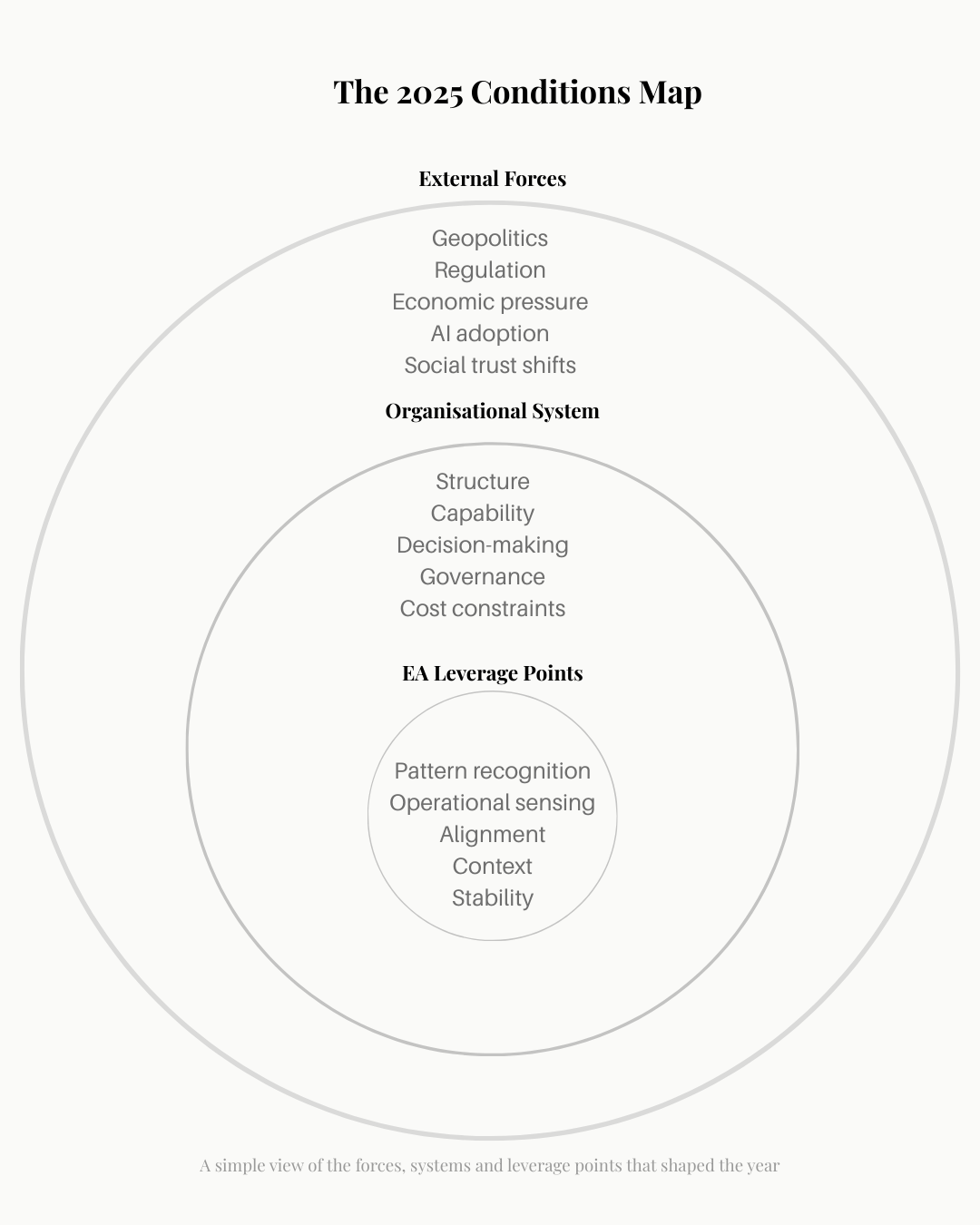
This map gives you a clear way to hold the year in your mind. It shows the forces outside your organisation, the systems inside it that absorbed the pressure and the leverage points you used every day to keep work moving.
The outer ring captures the external forces shaping decisions in 2025.
The middle ring shows how those forces played out inside organisations.
The inner ring reflects where you worked and the judgement you used to stabilise pace, alignment and delivery.
-
This map makes one thing clear.
-
You weren’t responding to tasks.
-
You were operating at the point where external pressure met internal strain.
-
And your work shaped how your organisation moved through the year.
Refer back to this map as you move through the tools in this edition. It will help you link your contribution to the conditions you navigated.
7. Deployment Tools
Every edition of The Brief is complete with deployment tools to help you bring concepts to life and track your contribution. As we look back at the year that was, use the tools included in this edition to pinpoint your impact in 2025 and set your performance goals for the new year ahead.
A. Impact Capture Framework
This tool helps you distil the real impact you had this year, especially in the messy conditions that shaped 2025. It gives you a simple way to capture the context you were working in, the contribution you made and the effect it had, so you can speak to your value without listing tasks or trying to remember everything you held together. It’s a clean, confidence-building way to make your influence visible.
B. Conditions-Based Impact Statements
This guide helps you turn the work you did this year into clear, senior-level impact statements. When the environment is complex, it can be hard to articulate your contribution without over-explaining or understating it. This tool gives you a simple structure to describe your role in a way leaders immediately understand, especially when you supported decisions, maintained momentum or created stability under pressure.
C. Performance Review Preparation Framework
This framework helps you prepare for your performance review without the overwhelm. It guides you to gather the evidence of your impact, anchor it in the realities you worked through and identify what you need next year to deliver at a higher level. It’s the quickest way to walk into your review prepared, grounded and able to speak clearly about your contribution. You could also use this as interview preparation.
D. 2026 Stretch Goal Builder
This builder helps you set stretch goals that actually mean something — goals that strengthen your capability, not your to-do list. It walks you through choosing the area you want to grow, the part of your role it applies to and what success will look like by the end of 2026. It’s a focused, senior way to plan your growth so you head into the year with intention and direction.
E. Ease and Influence Planning Map
This planning map helps you design the conditions that will make next year smoother and more sustainable. It guides you through the key levers that shape your work — meetings, communication rhythms, relationships, decision points and workflows — so you can refine the areas that create friction and strengthen the ones that support ease. It’s a practical way to set 2026 up with more clarity and less noise.
8. Emerging Capabilities For 2026
Heading into 2026, these are the capabilities that will define high-value EA work. They meet the realities of the environment and the expectations leaders now have.
Pattern recognition.
Spotting early themes across workload, relationships and organisational pace.
Contextual intelligence.
Understanding the business, the stakeholders and the implications of timing.
Systems awareness.
Seeing how work connects across functions and sensing where friction will appear.
Operational sensing.
Recognising capacity limits, misalignment and early indicators of delay.
Commercial awareness.
Understanding how cost pressure, risk and market movement shape decisions.
Critical thinking.
Testing assumptions and avoiding group thinking, especially as AI increases templated output.
Guardrail building.
Shaping boundaries that protect focus, expectations and quality.
Insight-led support.
Bringing interpretation, not just information, to decisions and conversations.
These capabilities will sit at the centre of high-value EA contribution next year.
9. The Posture For 2026
Organisations will need people who reduce noise, support stability and help leaders navigate decisions that come with more risk and fewer certainties. EAs who thrive will work with intention, ask precise questions, understand the broader environment and help create conditions where leaders can think clearly. The emphasis will shift from pace to discernment and from volume to judgment.
10. Editorial Close
You’re already working in the intersections this year revealed. The opportunity now is to recognise it, refine it and use it with intention. The environment will continue to shift in 2026, particularly as AI becomes more integrated. Your ability to read the shifts and support leaders through it will shape the impact you have next year.
11. How To Use The Brief With Care
The Brief is designed to inform your perspective, not prescribe action. Use it to understand the environment shaping your organisation and to sense where your support will have the most impact. Apply what aligns with your context and leave what doesn’t. Integrate insights slowly and deliberately. This isn’t a performance checklist. It’s a resource for informed decision-making.
12. Audio Briefing
Your 5 minute audio Brief is here.