Theme: Through the Turns: How EAs Keep Leaders Effective When the Playbook Disappears
From The Editor
The most capable leaders are struggling right now — not because they’ve lost skill, but because the conditions that make success possible have shifted faster than their systems can adapt.
Across the International Monetary Fund’s latest World Economic Outlook, the World Economic Forum’s mid-year Chief Economists Outlook, and recent analyses from Harvard Business Review and McKinsey & Company, one pattern stands out: volatility has become the default setting for business. Predictability, once a basic operating condition, has all but disappeared.
For executive assistants, this moment in time is uniquely demanding. The rules that used to keep organisations steady — reliable forecasts, clear stakeholder sponsorship, consistent decision rhythms — no longer hold. Yet it’s within this uncertainty that an EA’s influence becomes most visible.
Across the boardrooms I work with, the tone isn’t panic — it’s recalibration, and rhythm is the new performance metric.
This edition explores how to help your executive lead effectively when the usual playbook no longer applies — and how to build your own steadiness and confidence in the process. It’s about translating the noise of a shifting world into the clarity that keeps work, people, and progress moving forward.
1. Market Pulse - Decoded For EAs
What happens when the usual conditions for success disappear?
When you look across global headlines right now, the message is clear: the world is in a permanent state of almost steady.
Leaders are trying to make decisions while everything around them keeps changing — trade rules, technology, budgets, expectations. That’s where executive assistants have enormous influence: helping leaders stay clear, calm, and focused when the plan no longer fits the moment.
Global Picture — In Plain Terms
The economy is wobbly, not broken. The IMF’s October 2025 outlook shows growth is continuing but uneven, and highlights trade policy and uncertainty as significant drags.
Executives are acting in faster cycles. The WEF’s May 2025 Chief Economists Outlook reports that uncertainty has become the dominant theme — many leaders expect to “plan while they move.”
Smart organisations are adapting rather than waiting. According to McKinsey, framing change as “taking the turns” means building rhythm, testing early, and deciding in shorter loops.
Sponsorship isn’t failing — it’s shifting. As formal structures compress, relationships and personal advocacy replace long-term formal mechanisms.
Local Lens
EMEA → Growth remains uneven and confidence fragile. Budgets are tight, and leaders are cautious about long-term commitments. Anchor conversations in near-term progress and low-risk pilots that can scale once certainty improves.
US → Confidence is mixed as leaders navigate new tariffs and shifting policy priorities. The advantage for EAs is perspective: distinguish what’s confirmed from what’s speculative, and surface decisions waiting on clarity.
APAC → Momentum is holding strongest. Teams are acting on early signals instead of waiting for consensus. Match that pace — shorten feedback loops, tighten timeframes, and help your leader move first.
Your Move
The opportunity in this climate isn’t just to keep things moving — it’s to help your executive move well. As planning horizons shorten and confidence wavers, your value lies in creating rhythm, not reaction. Keep decisions small, cycles tight, and communication crisp. The steadier your systems, the steadier your leader.

Stretch Yourself
-
Notice the turning points early.
When you sense the pattern shifting — priorities slowing, tone tightening, or decisions stalling — be the one who names it calmly and suggests a reset. -
Champion lighter, faster communication.
Replace long updates with visuals, short summaries, or dashboards. This isn’t about simplification — it’s about speed to clarity. -
Shape the rhythm, don’t wait for it.
Suggest a regular check-in or review cadence that helps your leader stay adaptive without losing focus. You don’t need permission to bring structure — you just need timing. -
Balance action with observation.
Progress isn’t always about doing more. Sometimes your most valuable move is noticing when the pace itself needs adjusting.
Back Pocket Confidence Cues
Use these in meetings, one-to-ones, or planning conversations — they show you understand both the business mood and what good leadership looks like under pressure.
- “If the plan shifts again, which outcomes do we need to protect most?”
- “Would it help to separate what’s confirmed from what’s still assumption?”
- “If we map the next four weeks first, we’ll see faster what’s working.”
- “What would signal that it’s time to pivot?”
- “We can test this safely now and adjust once we have proof of direction.”
2. Decoded Visual Snapshot
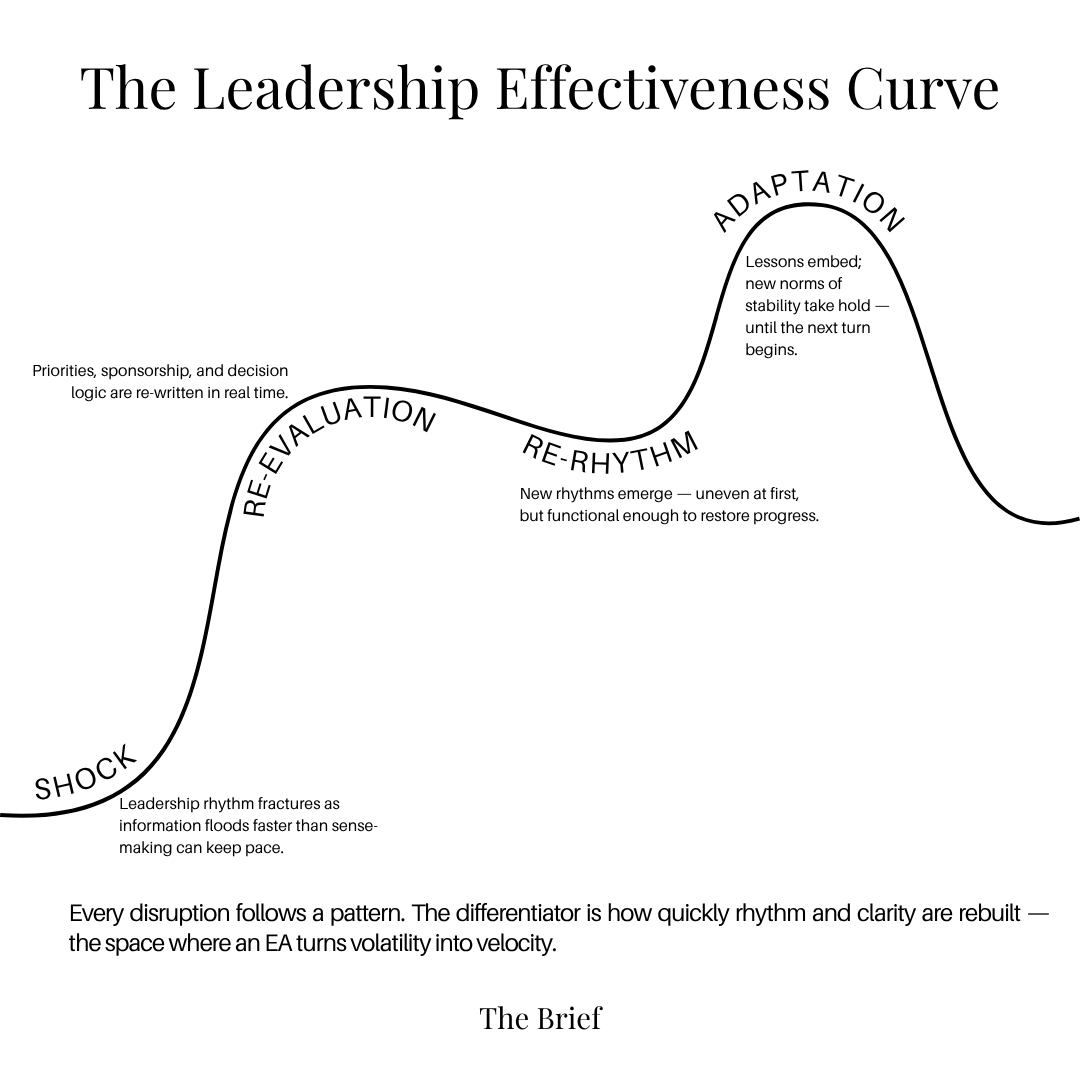
When stability disappears, even strong leaders can lose their footing. Decision quality dips, priorities scatter, and the pace that once drove success starts working against them.
The pattern is predictable — first the shock, then a scramble to re-evaluate, a slow return to rhythm, and finally, adaptation.
What changes from one organisation to the next is how quickly that rhythm returns — and that’s where an EA makes the difference.
By restoring structure, clarity, and cadence, you help your leader move through disruption faster, turning volatility into momentum.
3. What The Headlines Aren’t Saying
The economy is still moving — but confidence inside boardrooms is not.
Behind the forecasts and optimism quotes, the real conversation is quieter: how do you lead well when everything that made you effective last year no longer works?
As Harvard Business Review writers Jenny Fernandez and Kathryn Landis observed, when stable funding, sponsorship, and predictable markets fall away, the habits that once drove performance start to fail. The issue isn’t capability — it’s context.
The International Monetary Fund’s October 2025 World Economic Outlook shows growth holding but uneven, with trade policy and financial volatility now replacing inflation as the main drag on confidence. The World Economic Forum’s latest Chief Economist's Outlook echoes the same sentiment: executives are “planning while they move,” balancing short-term survival with long-term uncertainty. McKinsey & Company calls this “winning through the turns” — thriving not by waiting for stability, but by embedding adaptability into rhythm, communication, and decision-making.
What doesn’t make the headlines is the friction and noise this creates behind the scenes:
- Strategy is shrinking. Leaders are planning in shorter bursts — it keeps momentum but limits long-range vision.
- Information is overwhelming. The signal-to-noise ratio has collapsed; leaders are surrounded by input but short on clarity.
- Decision quality is slipping. Fatigue is setting in, and even experienced executives are second-guessing instinct.
For executive assistants, this is the terrain that defines 2025.
The opportunity isn’t to keep pace — it’s to help leadership regain rhythm faster: filtering what matters, shaping communication flow, and reinforcing structure when everything else feels unstable.
What This Means for You as an EA
The leaders who move well through disruption have something in common: they’re supported by EAs who can see the turn before it happens.
This isn’t about reacting faster — it’s about thinking higher.
Here’s how to stretch your focus this quarter:
-
Anticipate the next turn, not the next task.
Instead of asking “What’s next on the list?”, start asking “What’s shifting beneath it?”
You’ll start spotting pattern changes early — tone, tempo, hesitation — and can adjust support before the strategy wobbles. -
Design for decision clarity.
When information overload is the enemy, your real power lies in editing.
Use simple formats — a one-page “What’s stable / What’s changed / What needs a call” — to replace noise with visibility. -
Shape rhythm, don’t wait for it.
If your leader’s week feels chaotic, create cadence: regular check-ins, shorter meetings, clear feedback loops.
Rhythm creates reliability — and reliability rebuilds confidence. -
Lead with composure.
When everyone else reacts, you regulate. The steadier your communication tone, the more influence you hold.
The EAs who will stand out in this climate aren’t the busiest — they’re the most intentional. They make uncertainty feel navigable, and they keep leadership energy directed where it matters most.
The Organisational Under-Current
Beneath market volatility sits a quieter shift: power and decision-making have become fluid. Informal networks, not formal hierarchies, are now driving outcomes. For EAs, influence sits in mapping those networks — understanding where momentum and resistance really live.
Stretch Yourself
In times like these, leadership strength depends on steadiness — and that starts with how you think, not just what you do.
To stretch yourself this quarter, focus on two shifts that separate reactive support from strategic influence:
-
Anticipate the next turn, not the next task.
Look beyond the to-do list. Listen for tone shifts, watch for recurring delays or reworded priorities — they often signal the next change before it’s announced.
When you spot the pattern early, you can prepare options and help your executive move first instead of catching up. -
Design for decision clarity.
When uncertainty is high, your real value lies in how you simplify.
Translate noise into visibility: one page that shows what’s stable, what’s shifted, and what needs a call.
It’s not just tidier communication — it’s strategic stabilisation.
The EAs who rise in this climate don’t chase certainty — they create it, through structure, foresight, and clarity.
EA Conversation Starters
Use these to open up conversations in the moment.
Each one is framed to make invisible risks or opportunities visible — and to position you as the person who connects the dots.
Operational / Tactical
These are practical, everyday prompts you can use in team meetings, planning sessions, or one-to-ones to keep rhythm and reduce reactivity.
-
“Would it help if I map what’s changed this week versus what’s still steady?”
-
“If we plan the next four weeks first, we’ll see sooner where the pressure points are.”
-
“Do you want me to track which actions we can reverse later and which are fixed?”
-
“Would a standing check-in help keep this moving without adding another full meeting?”
-
“I’ve noticed updates are doubling up — would you like me to streamline the flow so everyone sees the same version?”
Strategic (C-Suite)
Use these with your executive or senior stakeholders to surface insight, shape thinking, and build trust as a strategic partner.
-
“If the current plan slows, which outcomes do we need to protect most?”
-
“What would tell us it’s time to pivot — and how will we know early enough to act?”
-
“Do we want to review which decisions are reversible so we can move faster where it’s safe to test?”
-
“How can we make our communication lighter but still keep everyone informed?”
-
“Would it help to set a rhythm for revisiting assumptions every few weeks instead of waiting for the next offsite?”
4. EA Influence Moves
This is where you move from being across the intel to actively shaping outcomes.
Influence isn’t about titles — it’s about spotting the gaps before anyone else does and stepping into them.
Through the turns, influence looks different.
When predictability disappears, the most valuable EAs aren’t those keeping up with change — they’re the ones directing how their executive office moves through it.
The shift now is subtle but powerful: from delivering support to designing stability.
You’re not just helping leaders make decisions; you’re shaping the conditions that allow good decisions to happen.
Strategic (C-Suite)
Moves that influence direction, pace, and clarity at the highest level.
-
Design the rhythm, don’t wait for it.
Introduce short, structured loops that keep decisions flowing even when priorities shift. Rhythm steadies performance. -
Create decision visibility.
Replace long reports with one-page summaries showing what’s stable, shifting, and waiting. Clarity protects cognitive energy. -
Be the calibration point.
When conversations scatter, pull focus back to the objective. Your composure becomes the anchor. -
Capture learning as currency.
After every pivot, document what changed and what was learned. Over time, this becomes the insight others rely on.
Practical (Operational / Tactical)
Moves that steady execution and reinforce structure when everything else feels fluid.
-
Run light, fast reviews.
Ten-minute “through-the-turns” check-ins keep work aligned without adding meetings. -
Simplify communication flow.
One update rhythm, one version of truth. Less traffic, more traction. -
Name the change early.
“Timelines are drifting — do we want to reset expectations now?” Neutral, factual, and ahead of risk. -
Document clarity.
Close every loop with a short recap or slide. Consistency builds trust faster than volume.
Stretch Yourself
Strategic (C-Suite)
→ Ask a better question.
Instead of offering solutions, frame questions that sharpen executive thinking.
“What assumptions are we still operating on that may no longer be true?”
Smart questions elevate you from support to strategic counsel.
Practical (Operational / Tactical)
→ Set the rhythm everyone relies on.
Be the one who calls time on chaos. A steady cadence of updates or check-ins turns scattered effort into collective momentum.
It’s not about doing more — it’s about creating ease through structure.
The through line: at every level, influence comes from rhythm and clarity.
When conditions keep shifting, the EA who holds steady — who filters noise, frames the next move, and creates continuity — becomes the most valuable constant in the room.
5. Practical Deployment Tools
Insight only matters if it can be used. These tools turn the concepts in this edition into motion — helping you translate awareness into rhythm, and rhythm into results.
A. The “What’s Changed” Snapshot
Purpose: Maintain shared clarity when conditions shift.
Create a simple one-page view that outlines three points: what’s still true, what’s changed, what needs a call. This replaces long updates with a real-time picture leaders can act on.
Use it in weekly briefings, pre-meeting notes, or to steady executive conversations after volatile news cycles.
B. Decision Menu
Keep decisions moving when conditions are uncertain — and to help your leader focus on what can be acted on now versus what needs more clarity.
How to use it:
This is a lens to structure thinking. When you present issues, frame each one under one of these three headings. It sharpens focus, reduces hesitation, and allows the executive office to maintain momentum without unnecessary risk.
C. Through-the-Turns Meeting Rhythm
Create structure and calm in unpredictable periods — maintaining strategic rhythm when conditions for success have shifted. This rhythm protects cognitive energy, speeds up learning, and keeps leadership focus tight without increasing meeting load.
D. Scenario Triggers
Move from reaction to readiness — helping your leader and teams act quickly when defined conditions change, without overplanning or panic. Scenario triggers make volatility measurable. They turn vague concern (“things feel off”) into structured awareness (“this signal means it’s time to pivot”).
E. Talking Points
“There’s a lot changing quickly — the value right now is in helping people see what’s still steady.”
Positions you as the calm voice focused on stability, not chaos.
“We’ve got plenty of data — what’s harder to get is a clear story about what it means.”
Opens the door to offer synthesis, not more information.
“Shorter planning cycles aren’t a setback — they’re how smart teams stay responsive.”
Normalises agility when others might feel unsettled by constant change.
“It feels like decisions are being made faster — would it help to map which ones are safe to test and which need a deeper look?”
Practical, low-risk way to introduce the Decision Menu idea in conversation.
“If priorities keep shifting, maybe we can lock in a quick weekly check-in so we catch changes early.”
Makes the Through-the-Turns Rhythm sound like a helpful solution, not an extra meeting.
“When things move this fast, the small systems — how we communicate, how we track — make the biggest difference.”
Helps others see process work as strategic support.
“The organisations that handle volatility best usually share one thing: rhythm.”
A polished line that summarises the entire edition’s insight and reinforces the EA’s value in creating it.
F. Impact Tracker
As conditions keep shifting, your ability to restore structure, clarity, and rhythm directly impacts leadership effectiveness and business continuity. This is your opportunity to make that work visible.
By tracking the actions that stabilise your executive office — the decisions you help shape, the rhythms you restore, and the insights you surface — you create tangible evidence of value. Use this tracker to capture how your contribution enables progress through instability and how your leadership partnership drives performance when predictability drops.
6. Executive Ready Notes
If you only have a few minutes — or you want prompts in front of you during a meeting — this one-page download is for you. It distills the key signals, implications, and talking points from this edition into a format you can scan quickly.
Think of it as your meeting companion sheet: the theme at a glance, three sharp questions to raise, framing language you can use, and deep-dive examples if you’re pressed for more context.
DOWNLOAD EXECUTIVE READY NOTES
7. Using The Brief With Care
This edition is about steadiness — the rhythm, structure, and composure that keep leadership effective when conditions turn. But using these insights well isn’t about adding new routines or claiming new ground. It’s about interpreting what’s happening around you and tailoring your actions to the reality your organisation is in.
A few principles to guide you:
1. Context decides impact.
Every organisation absorbs change differently. In one, the most valuable move may be simplifying communication; in another, it’s restoring pace through tighter check-ins. Read the environment first, act second.
2. Influence through translation.
Your value comes from making complexity usable. Don’t forward trend reports or volatility data — interpret them. “Investor sentiment is shifting toward resilience; should we review how we present stability in our next update?”
3. Build confidence, not commentary.
When conditions are uncertain, speculation fuels noise. Bring focus back to what’s known and what’s next, and present each move as a stabilising step, not a reaction.
4. Calibrate ambition to timing.
This isn’t the moment to overhaul systems; it’s the moment to refine them. Small, visible improvements — cleaner meetings, clearer updates — build credibility and momentum.
8. Going Deeper
- McKinsey- Winning Through The Turns: How Smart Companies Can Thrive Amid Uncertainty
- Harvard Business Review - How To Lead Through Uncertainty - this article is behind a paywall but you can read it through this gifted link
- World Economic Forum - Uncertainty Is The Watchword as Chief Economists Assess The State Of The Global Economy
- World Economic Forum - Global Economy In Flux, Prospects Remain Dim
9. Audio Briefing
If you only have five minutes, start here.
This month’s audio briefing distils the market context and leadership conditions shaping Edition 03 — what’s happening behind the headlines, why it matters, and the opportunity it creates for you.
You’ll hear how shifting economic conditions are reshaping leadership effectiveness, the quiet challenges executives are navigating inside boardrooms, and where EAs can add the most stabilising value when predictability drops.
Listen in for the highlights reel: the key conditions, the core insight, and the opening your steadiness creates when everything else is moving.