Work Reimagined — AI’s Hidden Jobs and the EA Opportunity
From the Editor
AI dominates executive conversations. Spend is soaring, functions are being consolidated or offshored, and headlines warn of job cuts. But the overlooked reality is this: AI is quietly creating roles that don’t even have names yet.
Consistency, workflow, adoption — these are becoming critical functions. The risk? They’re invisible unless someone claims them. The opportunity? EAs already do this work every day. This month, we surface the signals, the gaps, and the openings for you to reframe and step forward.
Many of you have told me you’re already using The Brief to brief your execs, guide risk conversations, or build confidence in the room. I’d love to know how you’ve been applying the intel so far.
Your stories will help shape what comes next.
– Rachael
1. Market Pulse — Decoded for EAs
Signals playing out now
-
Adoption = trust. Morgan Stanley’s AI assistant hit 98% adoption only after governance guardrails. → Trust before rollout.
-
Training gap. Nearly half of employees want AI training; only 28% of orgs plan to invest. → Adoption stalls without support.
-
Consolidation wave. Grant Thornton offshored secretarial and support roles; Big Four firms are downsizing and shifting back-office functions overseas. → Cost play, but context disappears.
-
New jobs. NYT: companies are already hiring consistency coordinators. → Hidden skills are becoming roles.
-
Failure risk. Gartner: 40% of agentic AI projects scrapped by 2027. → Outcomes, not usage, must be measured.
Local Lens
-
US: High spend, boards pushing hard for ROI.
-
APAC: Telecoms lead the charge. Telstra’s $700m JV with Accenture embeds AI across all functions; Singtel targets one-third of revenue from AI by 2030. → Not just efficiency — growth strategy.
-
EMEA: The EU is drafting a Code of Practice on AI transparency under the AI Act. → Governance, and disclosure will be mandatory in 2026.
Your Move
Reframe your hidden work in the language executives listen for: adoption, trust, workflow design, transparency.
-
“I keep projects on track” → “I safeguard consistency so outputs are usable.”
-
“I prepare board papers” → “I ensure decision-making material is accurate and transparent.”
-
“I support process change” → “I champion adoption so efficiency gains actually land.”
Stretch Yourself
Don’t just support change — champion it.
-
Spot one workflow where AI is being trialled informally and bring structure: map how it’s being used, who’s using it, and whether outputs are consistent.
-
Name yourself in the role: “I’ll champion adoption for this pilot — I’ll track issues, surface gaps, and make sure improvements stick.”
-
Start building an “outcome vocabulary” — use words like efficiency, governance, and transparency when you describe the value you bring.
Back-Pocket Confidence Cues
-
“If no one is responsible for governance here, that’s where issues will show up.”
-
“Transparency is what builds trust in the outputs — without it, adoption won’t follow.”
-
“Efficiency isn’t just about the tool — it’s about whether workflows are designed to make the most of it.”
-
“Context matters. When roles are offshored, who’s making sure we don’t lose that?”
2. Decoded Visual Snapshot
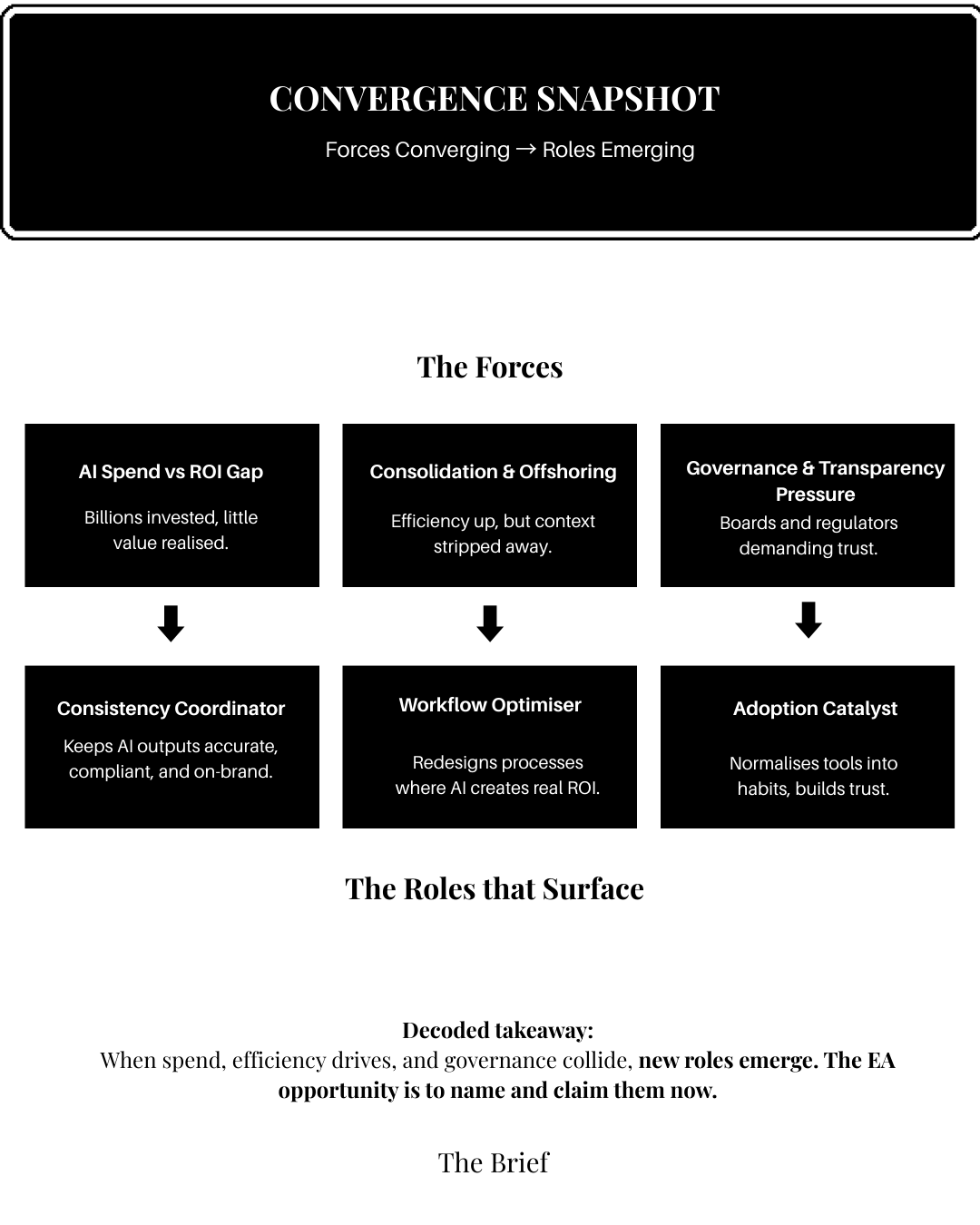
The pressure on executives isn’t coming from one direction — it’s the convergence of forces. Massive AI spend without clear returns, efficiency moves like offshoring, and rising demands for governance and transparency are colliding at the same time.
When those forces meet, new roles start to surface. They’re not yet written into org charts, but they’re already critical: someone to ensure consistency, someone to redesign workflows, someone to make adoption stick.
The snapshot below shows how these forces converge — and the hidden jobs that emerge as a result.
3. What Headlines Aren’t Saying
AI isn’t just cutting jobs. It’s creating new ones — invisible unless claimed. Offshoring strips away context at the moment AI adoption needs it most. And while organisations hype efficiency, the real prize is reimagining work.
Clues & Cues to watch for
-
Shadow AI experiments happening in teams.
-
Execs talk spend, not outcomes.
-
Reports or outputs less consistent since AI arrived.
-
Functions earmarked for offshoring.
-
No clear owner for adoption or governance.
When you see these, it’s your opening.
Stretch Yourself
-
Write a “mini role description” for your hidden governance/adoption work.
-
Shift from task to outcome language in meetings.
-
Spot colleagues with hidden skills (compliance, PMO, risk) who could be allies.
EA Conversation Starters
Use these to open up conversations in the moment. Each one is framed to make invisible risks or opportunities visible — and to position you as the person who connects the dots.
Ops / Tactical
-
“We’re already using AI here — do we want to track what’s working and what’s breaking down?”
-
“When we send this offshore, who’s keeping an eye on whether context is lost?”
-
“Where should we add a quick consistency check so outputs don’t slip through?”
-
“Do people need a walk-through on how this tool actually fits into their workflow?”
Strategic
-
“Who is accountable for adoption and governance — or is it assumed to happen on its own?”
-
“Are we measuring outcomes or just usage?”
-
“Which workflows are best reconfigured with AI before we decide to cut or consolidate?”
Back-Pocket Confidence Cues
These are short lines you can use to show you’re across the issue — without overstepping your role. They open doors for influence and position you as connected to what matters.
Ops / Tactical
-
“Context can get lost when tasks are moved offshore — we’ll need to watch for that.”
-
“If no one’s checking consistency, we’ll see errors creep in.”
-
“Adoption won’t stick unless the tool fits naturally into daily workflows.”
Strategic
-
“Governance is what makes adoption scalable.”
-
“Transparency builds trust — and that’s what makes AI outputs usable at senior levels.”
-
“Efficiency is only real if workflows are redesigned, not just automated.”
4. EA Influence Moves
This is where you move from being across the intel to actively shaping outcomes. Influence isn’t about titles — it’s about spotting the gaps before anyone else does and stepping into them.
Strategic (C-suite)
-
Position yourself as the translator. When leaders talk about spend, pivot the conversation to outcomes, governance, and adoption. That makes you the person showing how AI value is actually realised.
-
Claim the unclaimed roles. Say, “No one owns adoption on this pilot — I’m happy to track uptake and surface gaps.” You’ve just stepped into the role of adoption catalyst before it even has a name.
Practical (Ops / Tactical)
-
Surface shadow AI use. Map where it’s already happening in your team. Show both benefits and risks — this makes you a consistency coordinator without needing permission.
-
Protect context. When tasks are offshored, flag what could be lost and offer to capture local knowledge so workflows stay usable. That’s workflow optimisation in action.
Stretch Yourself
-
At the C-suite level: tie adoption and governance directly to ROI — “if we want value, here’s how we measure it.”
-
At the ops level: make wins visible — highlight one workflow where efficiency improved because you safeguarded consistency.
The through-line: These influence moves are how you turn invisible, unnamed work into recognised value. Every time you take ownership of adoption, consistency, or context, you’re not just helping — you’re creating the role others haven’t yet realised they need.
5. Practical Deployment Tools
A. Talking Points
-
What guardrails are in place before rollout?”
-
“Where’s the adoption plan — and who owns it?”
-
“Which workflows lose context if offshored?”
-
“Are new AI-enabled roles being named, or left invisible?”
-
“Do we have a way to track value beyond usage?”
-
“Who’s capturing the issues we’re seeing with this tool, so they can feed into improvements?”
-
“Do we need a simple check before this goes out, so the outputs are consistent?”
B. 30-Day Scan
The fastest way to make your value visible is to show you’re already working where AI succeeds or fails. Use this 30-day scan to spot openings, reframe your role, and surface opportunities no one else is naming.
C. Scenario Triggers: What to Say When the Moment Lands
These are the real-world lines you’ll overhear in meetings. Use these responses to step into the hidden roles AI is creating.
D. Impact Tracker
AI spend is rising, roles are being collapsed, and efficiency pressures are peaking. In the middle of this, adoption, trust, and context are often overlooked — yet they are the very levers that decide whether AI and consolidation succeed or fail.
This is your opportunity. By tracking your actions in these areas, you not only prove your impact, you also start to see where you are already stepping into the invisible jobs this edition has surfaced.
Use this tracker to guide where to lean in — and to capture the outcomes that show your value is essential.
6. Executive Ready Notes
If you only have a few minutes — or you want prompts in front of you during a meeting — this one-page download is for you. It distils the key signals, implications, and talking points from this edition into a format you can scan quickly.
Think of it as your meeting companion sheet: the theme at a glance, three sharp questions to raise, framing language you can use, and deep-dive examples if you’re pressed for more context.
DOWNLOAD EXECUTIVE READY NOTES
7. Using The Brief with Care
This edition is about invisible roles — the adoption catalysts, consistency coordinators, and workflow optimisers that don’t yet have names on paper. But claiming space in these areas isn’t about announcing “I’ll do it.” It’s about connecting the dots between what you see, the risks you can head off, and the business benefits that matter right now.
A few principles to guide you:
-
Context is everything. Tailor your move to where your organisation is. If your company hasn’t started its AI journey, your influence may begin with tracking shadow use and surfacing adoption gaps. In a more advanced organisation, you might frame yourself as the person who keeps outputs consistent and compliant.
-
Build the case, not just the claim. If you want to own a new responsibility — whether that’s adoption, governance, or a special project — be ready to link it to business benefits. Efficiency, transparency, and reduced risk are the language that gets it across the line.
-
Prepare for the leap. If you’re stepping into a bigger role, have your business case ready: What’s the value of you owning it? What risks are reduced? What unique perspective do you bring?
-
Surface, don’t forward. Don’t drop a McKinsey or news link in your exec’s inbox. Instead, translate it: “Telstra’s AI investment shows where leaders are going — here’s what it could mean for us/should we talk about this as a leadership team.”
9. Going Deeper
-
McKinsey: Reconfiguring Work: Change Management in the Age of Gen AI (Aug 2025)
-
New York Times: AI Is Creating Jobs You’ve Never Heard Of (June 2025)
-
Singtel: Accelerates workforce transformation with AI (Sept 2025)
Audio Briefing
Prefer to listen instead of read? This is your five-minute download — the context behind this edition, the big shifts to notice, and the cues you can carry straight into your week.
This month’s audio briefing covers:
-
Why massive AI spend isn’t yet delivering value
-
How consolidation and offshoring create hidden fragility
-
The invisible jobs already surfacing in organisations
-
Practical ways to frame your work in adoption, governance, and context
-
The sharp questions that make your value visible right now